LLM optimization for brands: Why your content strategy needs to change now
Discover how LLM optimization for brands improves AI visibility, earns brand mentions and strengthens your content strategy.
Ranking #1 on Google used to feel like the finish line. Now there's a catch. Someone can ask ChatGPT, Gemini or Perplexity for a recommendation, get a short list of brands and never open a results page at all. A 2026 Pew Research Center survey found that 49% of U.S. adults now use AI chatbots, up from 33% two years earlier, and about one in four use them daily. If your brand is missing from those answers, a growing share of buyers will never meet you, no matter where you rank.
That is why LLM optimization for brands now belongs in every content strategy. In this guide, we'll explain what it means, why SEO alone isn't enough anymore and what you can do to get started this month. We run SEO and LLMO together at Sociyell, so everything here is practical, not theory.
What is LLM optimization (LLMO)?
LLM optimization for brands is the practice of making your content and online presence easy for AI tools like ChatGPT, Gemini, Perplexity and Claude to understand, trust and mention in their answers. The goal is no longer just to rank higher on Google. You also want your brand to show up when people ask AI tools for advice, answers or recommendations.
ChatGPT and Gemini use what they learn from text to answer your questions. When someone asks a question, AI may recommend certain brands or mention specific websites. This means your brand needs to be visible not just on search engines, but also in the places people now turn to for answers.
You'll also see two related terms:
- GEO (generative engine optimization) focuses on visibility inside generative search experiences.
- AEO (answer engine optimization) focuses on appearing in direct answers, such as featured snippets, voice results and answer boxes.
- LLMO takes a wider, model-focused view: helping large language models understand and reference your brand.
All three work in similar ways, so we'll use LLMO throughout this guide. To learn more, check out our complete guide on what LLMO is.
LLM optimization vs SEO: Key differences
| Basis | Traditional SEO | LLM optimization |
|---|---|---|
| Goal | Rank high on the results page | Get cited and recommended in AI answers |
| Ranking unit | A web page | Your brand as an entity, plus individual passages |
| Success metric | Position, clicks, impressions | Mentions, citations, how you're described |
| Content format | Built for crawlers and readers | Built for readers, with answers an AI can lift cleanly |
| User behavior | Scan links, click, compare | Ask a full question, read one answer, act on it |
The simplest way to remember it: SEO wins clicks. LLMO wins mentions and recommendations.
They are not rivals. Technical SEO, clear structure, schema, E-E-A-T and authority all feed LLMO too. LLMO builds on SEO to help more people find your brand through AI tools.
Why your content strategy needs to change now
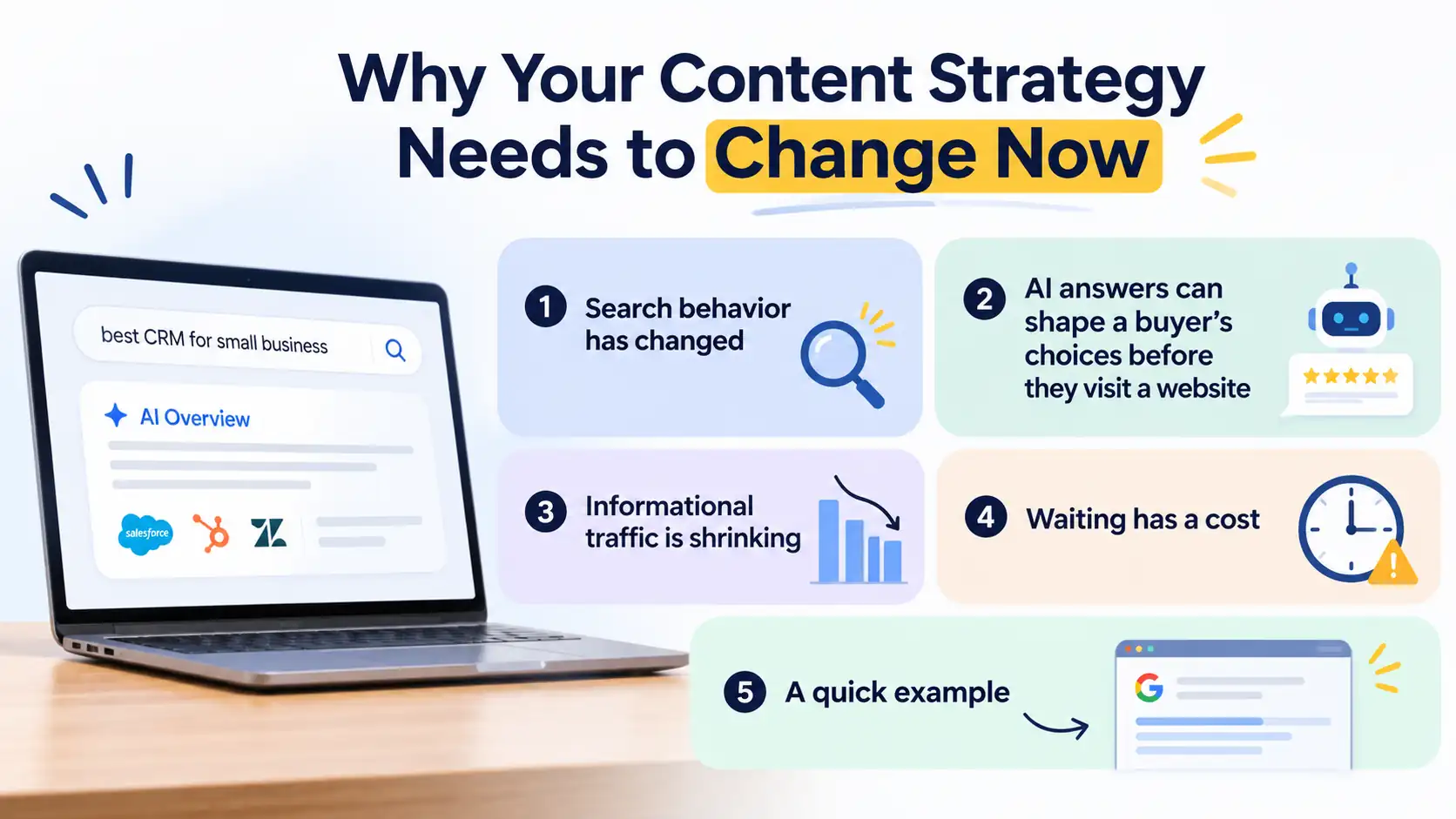
1. Search behavior has changed
People aren't just typing two-word queries anymore. Pew found that the most common reason people use chatbots is to search for information, at 42%. And longer, conversational questions are exactly what trigger AI answers: in Pew's browsing study, only 8% of one- or two-word searches produced an AI summary, compared with 53% of searches with ten or more words.
2. AI answers can shape a buyer's choices before they visit a website
Imagine someone asking an AI tool to suggest the best AI content agencies for D2C brands. They look at the suggested options, compare them and choose which agency they want to reach out to. Your website was never part of that journey. If you weren't named, you weren't considered.
3. Informational traffic is shrinking
Pew tracked real Google users and found the pattern clearly. When an AI summary appeared, people clicked a regular result link in 8% of visits, versus 15% when there was no summary. Clicks on links inside the summary itself happened in just 1% of visits. The summary is often the whole answer.
4. Waiting has a cost
Building trust with AI tools takes time, but the results can grow over time. In Ahrefs' study of 75,000 established brands, 26% had zero mentions in Google AI Overviews. The brands already being mentioned keep getting reinforced, so late movers end up competing against that head start.
5. A quick example (illustrative, not a client case)
A skincare brand ranks #1 for “best vitamin C serum for sensitive skin.” But when someone asks an AI tool the same question, it names three competitors that are praised in reviews and community threads. The brand has the ranking and none of the recommendations. That gap is what LLMO closes.
Benefits of LLM optimization for brands
- Visibility where decisions now happen. Your brand becomes part of the answer, not just another search result.
- Better leads. People who discover your brand through AI recommendations may already understand what you offer and why it suits their needs.
- Stronger trust. When an AI tool mentions your brand, people may be more willing to consider you than they would be after seeing a regular ad.
- A hedge against search changes. Content that is clear, structured and credible holds up no matter which platform wins.
- Less wasted effort. Clear content systems cut rework.
How LLMs decide which brands to mention
AI tools find and mention brands through two main pathways.
1. Training data is what AI learns before answering queries. If your brand is consistently discussed across reliable sources, that reputation can become part of what the model “knows.”
2. Real-time retrieval (RAG) looks up the newest information available online when a question is asked. This is why your up-to-date service pages and expert articles matter right now, not only in the long run.
Beyond those pathways, four things shape who gets named:
- Entity recognition. AI tools start to associate your brand with certain topics. When your brand is often mentioned alongside LLMO, AI content and AI search, AI tools may link your brand to these topics.
- Source trust. AI tools lean on sources they consider credible. In Pew's analysis, Wikipedia, Reddit and YouTube together made up about 15% of the sources in Google's AI summaries.
- Extractable content. Pages with clear headings, simple explanations and useful lists make it easier for AI tools to find and use information.
- Consistent information. If your website and other online profiles share different information about your brand, AI tools may get confused about what your business actually offers.
LLM content operations: How LLMs transform content workflows
LLMs are changing more than how people find your brand. They're also changing the way businesses create content.
Traditional workflow vs LLM-assisted workflow
| Stage | Traditional | LLM-assisted |
|---|---|---|
| Research | Manual, slow | Faster topic and question discovery |
| Drafting | Written from scratch | AI first drafts, human rewrites |
| Repurposing | One piece, one format | One idea turned into many formats |
| QA | Manual review only | AI checks plus editor sign-off |
| Refresh | Rarely done | Regular, scheduled updates |
Where larger organizations use it:
- Creating more content for different pages and platforms
- Personalizing messaging for different audiences
- Localizing content for different markets
- Making it easier for teams to find and reuse information
What to sort out before you implement:
- Governance: decide who checks and approves content and how AI can be used
- Brand voice control: simple guidelines to keep your content in your brand's style
- Human review: a human editor checks every piece of content before it goes live
- Data security: know what you're pasting into which tool
- Team training: teach your team how to use AI and when to make changes
This is also where our AI content production work fits: turning the photos, clips and ideas you already have into a steady, on-brand content engine.
How to optimize for LLMs: Best practices and strategies
Here's the playbook for LLM optimization for brands, with a quick example for each step.
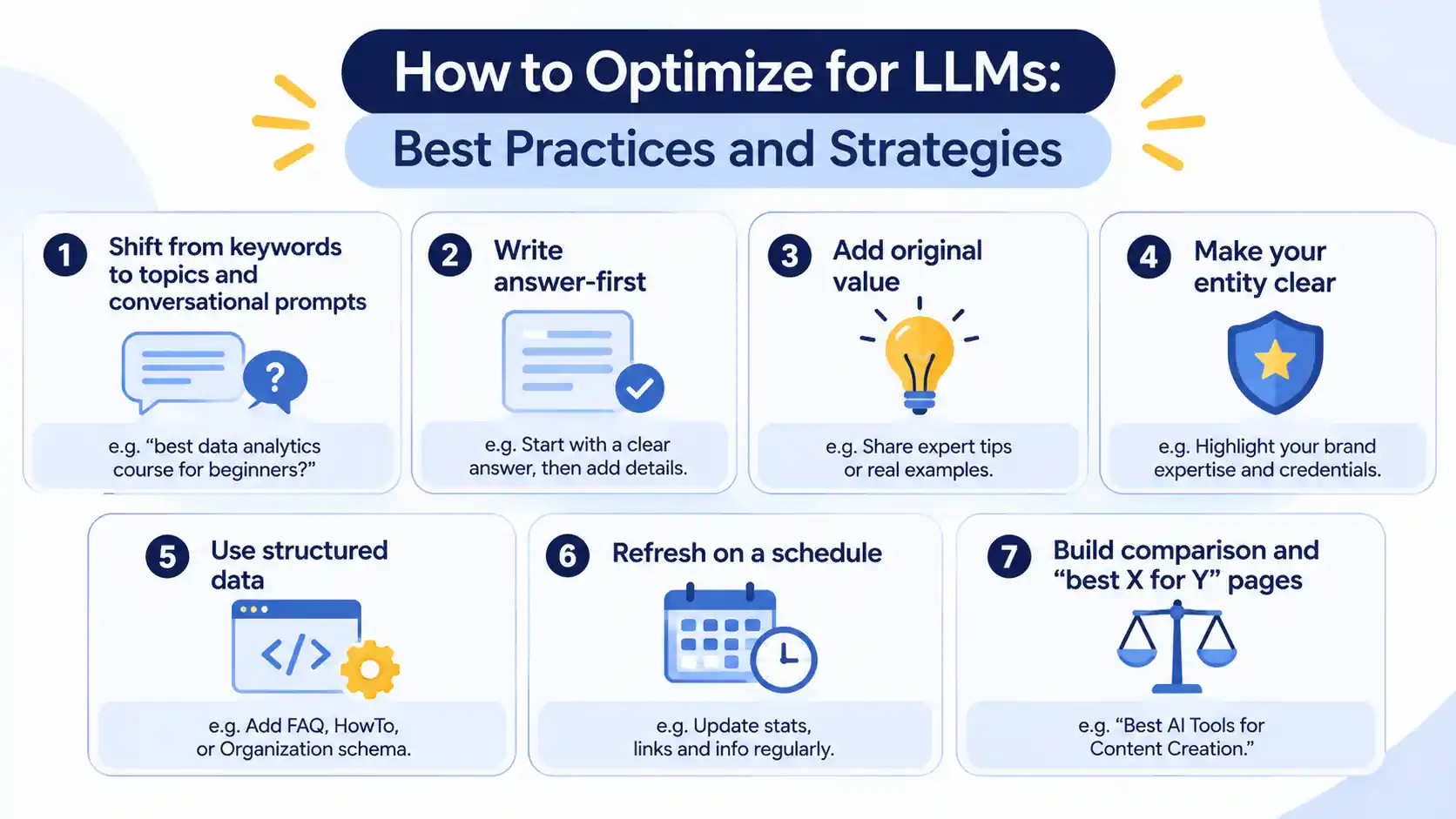
1. Shift from keywords to topics and conversational prompts
Map the full questions your buyers ask, not just short keywords.
Example: instead of only targeting “CRM software,” cover “which CRM works best for a five-person agency?”
2. Write answer-first
Give the answer first, then add proof with an example.
Example: open with “LLMO helps AI systems understand and cite your brand,” then explain.
3. Add original value
Proprietary data, case studies and expert input make content worth citing. In the original GEO research, adding relevant statistics, quotations and citations improved visibility by up to 40% in the study's testing, though results varied by domain and method. We cover that research in our LLMO guide.
Example: publish a small survey of your own customers.
4. Make your entity clear
Use the same brand name, one-line description and positioning everywhere.
Example: if your site says “AI marketing studio” and LinkedIn says “design agency,” pick one and align both.
5. Use structured data
Organization, Service, FAQ and Article schema label your content for machines. Make sure the markup matches what's visible on the page and validate it with Google's Rich Results Test. Schema helps understanding but doesn't guarantee a citation.
6. Refresh on a schedule
Review key pages quarterly and update outdated stats, examples and links.
Example: a page promising “the latest statistics” with two-year-old numbers loses trust fast.
7. Build comparison and “best X for Y” pages
Buyers ask AI to compare. Publish honest comparison and alternatives pages so the model has accurate material about where you fit.
Example: “Best project tool for remote design teams,” with fair pros and cons.
Off-site signals that drive AI brand mentions
What others say about you often matters more than what you say about yourself. Ahrefs' 75,000-brand study found branded web mentions correlated with AI Overview visibility at 0.664, while traditional backlinks came in at just 0.218. A later Ahrefs analysis went further: YouTube mentions showed the strongest correlation of any factor, at about 0.737, across ChatGPT, AI Mode and AI Overviews. One honest caveat from the researchers: correlation does not equal causation. Bigger brands naturally have more of everything. Still, the direction is clear. Unlinked mentions count and they're worth earning.
Where to build them:
- Digital PR: features and quotes in niche publications
- Review platforms: G2, Capterra, Trustpilot or Google reviews, depending on your industry
- Communities: Reddit, Quora and LinkedIn conversations
- YouTube: videos, interviews and demos that name your brand
- Guest posts and podcasts: expert appearances that tie your name to your topic
8-point audit checklist:
- Is your brand name described the same way on your site, LinkedIn and directories?
- Do you have a Wikipedia or Wikidata entry, if you qualify?
- Are your review profiles claimed and up to date?
- Have you been quoted in any industry publication this year?
- Are real people discussing you on Reddit or Quora?
- Does YouTube have videos that mention your brand?
- Do podcasts or guest posts connect you with your core topic?
- Is your founder or expert team visible and credited on trusted sites?
Advanced LLM optimization techniques
- Prompt-cluster mapping. Group the prompts your buyers use by intent (compare, price, how-to, best-for) and build one strong page or section per cluster.
- Topical and entity hubs. Link related pages around one core topic so your site shows depth, not scattered posts.
- Platform-by-platform optimization. AI tools use different sources and retrieval systems. Test each one separately and note which sources each trusts.
- Managing crawler access. Check that your robots.txt isn't blocking important pages and avoid keeping key information hidden behind heavy JavaScript. You may also hear about llms.txt, a proposed file that gives AI systems a cleaner site overview. Google says it isn't required for Google Search or its AI features. Treat it as optional, never as a shortcut.
- Correcting how AI describes you. If an AI gets your services or positioning wrong, find the source it's using and fix or strengthen the correct version there.
Step-by-step: Audit your brand's AI visibility
You can run this audit yourself in an afternoon.
- Build a prompt list. Write 20 to 30 questions your buyers would actually ask an AI.
- Test across platforms. Run them in ChatGPT, Gemini, Perplexity, Claude and Google's AI results.
- Record the results. Note whether you appear, how you're described and who else is named.
- Identify the sources. See which sites the AI cites or draws from.
- Find the gaps. Spot missing content, weak entity signals and thin off-site presence.
- Build a 90-day roadmap. Prioritize quick fixes first, then bigger content and authority work.
A simple tracking sheet: make one row per prompt, with columns for platform, mentioned (yes/no), how you were described, competitors named and sources cited. Repeat monthly and compare.
Measuring LLM optimization success
What to track:
- AI share of voice: how often you appear compared with competitors across the prompt list
- Citation frequency: how often your pages are cited as sources
- Sentiment and accuracy: whether the description of your brand is positive and correct
- AI referral traffic: in GA4, segment sessions coming from AI platforms such as chatgpt.com or perplexity.ai
- Branded search lift: more people searching your name after seeing you in an answer
Tools: Google Search Console shows your presence in Google's AI features only, not ChatGPT, Perplexity or Claude. For those, manual prompt testing works and paid AI-visibility trackers such as Ahrefs Brand Radar can automate it. Check current features and pricing before you commit.
Realistic timelines: SEO traction typically builds over 60 to 90 days. AI visibility can show up faster when tools retrieve fresh content in real time, sometimes within weeks. It takes months for a model to learn about your brand.
A note on attribution: it's imperfect. Many buyers see your name in an AI answer, then search for you directly later. Report on the trend across mentions, referral traffic and branded search together, rather than demanding one clean number.
LLM optimization for brands in action: Examples by industry
These are illustrative scenarios, not client results.
- SaaS: a project tool builds comparison pages and a clear “best for” statement. AI answers start describing it accurately for small remote teams.
- E-commerce: a skincare brand collects detailed reviews and ingredient explainers. It gets named in “best for sensitive skin” prompts instead of only ranking for them.
- Agencies and service brands: a consultancy publishes original benchmark data and gets quoted by trade publications, which feeds more AI brand mentions.
- Local businesses: a dental clinic keeps its address, services and hours identical across directories and answers common patient questions on one clear FAQ page.
- Coaches and creators: a coach publishes a clear point of view, appears on podcasts and posts YouTube explainers. AI tools now link their name with their niche.
- Rebrands: a company changes its name and positioning. Months later, AI tools still describe the old offer. Updating the site, schema, profiles and third-party listings together fixes it.
Common mistakes to avoid
- Treating LLMO as a replacement for SEO. It sits on top of SEO. Skip the foundation and both suffer.
- Mass-producing thin AI content. More pages with nothing original to say doesn't build authority or earn AI brand mentions.
- Ignoring the off-site picture. Your own site is only part of what AI reads about you.
- Locking out AI crawlers by accident. Re-check access after every site update or migration.
- Sending mixed messages. Different descriptions of your business across channels weaken the picture the model forms.
Hire LLM optimization experts: How to choose the right partner
1. Where to hire LLM optimization experts for brand content
- Agency: best if you need strategy, content, technical work and off-site authority handled together.
- Freelancer: good for a specific piece, like schema or a content audit, but harder to scale.
- In-house hire: gives control, but the skill set is new and still rare.
- Hybrid: an in-house marketer working with an agency for strategy and execution.
2. Choosing the best LLM optimization partner in the USA
Look for a team that understands how US buyers actually search and which review sites, publications and communities AI tools trust in your category. Ask for proof they've tested prompts across several AI platforms, not only Google. Sociyell works with brands across the US, UK, Canada, UAE, France and Australia and combines SEO and LLMO under one roof.
3. Affordable LLM optimization for local brands
You don't need a huge retainer to start. A sensible low-cost path: begin with an audit, fix your core service pages and business information, then add monthly content and mention-building. Ask any provider for a scoped package and for what comes first if the budget is tight. Pricing varies by competition and workload, so get a quote based on your audit, not a generic list.
4. Trusted agencies for rebranding projects
A rebrand changes more than your logo. AI tools can keep repeating your old name or offer until every source is updated. Look for an agency that handles branding and search together. Ours covers branding and identity alongside SEO and LLMO, so naming, messaging, site and AI visibility change at the same time.
5. Evaluation checklist
- Clear case studies with real, explained results
- Transparent monthly reporting
- Coverage of multiple AI platforms
- A white-hat approach based on useful content and real authority
- A willingness to audit what you already have, not rebuild everything
6. Red flags
- Guaranteed AI rankings or guaranteed ChatGPT mentions
- No clear methodology
- Promises of instant results
- Pushing spammy or mass-produced content
Implement LLMO with Sociyell
Here's the short version of everything above:
- Search has split in two. People still use Google, but a fast-growing group asks AI tools and those tools decide who gets named.
- Visibility now means being mentioned, not just ranked. Clear answers, consistent entity signals and trusted third-party mentions are what earn AI brand mentions.
- SEO and LLMO work best together. One gets you found, the other gets you recommended.
At Sociyell, we combine traditional SEO and LLMO in one service, so you don't need two agencies pulling in different directions. Our SEO and LLMO service covers content strategy and keyword research, on-page optimization, answer-focused structuring so AI tools can cite you, link building and authority development, technical SEO audits and monthly reporting with ranking tracking. We work with what you already have, audit the gaps and build a prioritized roadmap, rather than starting from scratch.
Want to know where your brand stands today? Get your free LLMO visibility audit and we'll show you how AI tools currently describe you and what to fix first.
For more, read our guide on how to get your brand mentioned in AI answers and our pillar page on what LLMO is.
Frequently asked questions
Is LLM optimization the same as SEO?
No. SEO helps your pages rank in search results and earn clicks. LLM optimization helps AI tools understand your brand and mention it in generated answers. They share a foundation of good content, clear structure and authority, which is why they work best together. Strong SEO gives you a head start but doesn't guarantee AI mentions.
What is the difference between GEO, AEO and LLMO?
They overlap heavily. GEO focuses on visibility in generative search experiences, AEO on appearing in direct answers and LLMO on helping large language models understand and reference your brand. In practice, one strategy covers all three: clear answers, structured content, strong entity signals and trusted third-party mentions. Pick one term for reporting and don't let labels slow you down.
How do I get my brand mentioned in ChatGPT?
Publish clear, direct answers to the questions your buyers ask, keep your brand information consistent everywhere and earn mentions on trusted third-party sites, reviews and communities. Then test real buyer prompts regularly to see how you're described. There's no switch to flip and nobody can guarantee a mention, but these steps raise your odds over time.
Does SEO still matter in the age of AI search?
Yes, more than ever as a foundation. Google still handles enormous search volume and AI answers often draw on the same strong, crawlable, well-structured content SEO produces. Drop SEO and you weaken both your rankings and your AI visibility. Treat LLMO as the layer on top, not a substitute.
How long does it take to see results?
SEO work usually builds over 60 to 90 days. AI visibility can move faster when AI tools retrieve your fresh content in real time, sometimes within weeks. Becoming part of what a model has learned takes months. Plan for ongoing effort, with early signals in the first month or two and stronger results over a quarter or longer.
Do I need an llms.txt file?
Probably not yet. It's a proposed file that gives AI systems a clean overview of your site and Google says it isn't required for Google Search or its AI features. Some platforms may use it, so it's cheap to add. But fix the basics first: accessible pages, clear answers, schema and authority.
Can small brands compete in AI answers?
Yes. AI tools reward clarity and credibility, not just size. A smaller brand with precise service pages, consistent information, honest reviews and a few strong third-party mentions can show up for specific, niche questions where big brands are vague. Win narrow prompts first, like your city, niche or exact customer, then widen out.
How much does LLM optimization for brands cost?
It depends on scope: how many pages need work, how competitive your category is and whether you need content production, technical fixes and off-site work. Most agencies price by monthly retainer or a scoped project. Ask for an audit first so the quote reflects your real gaps, not a generic package. See Sociyell's SEO and LLMO service.