Social media management for coaches: What to post when you sell transformation
Social media management for coaches made simple: 40+ post ideas, a content plan and a way to turn followers into discovery calls.
If you coach for a living, you already know the awkward part about posting online: you're not selling something people can hold. You're selling a version of their life that doesn't exist yet. That's why “just share value” advice falls flat and why so many coaches post for months and end up with a few likes and zero inquiries.
Here's the short answer. Good social media management for coaches comes down to three things: show the transformation (before, bridge, after), build trust with proof and honest stories and always leave an easy way to start a conversation.
This guide walks you through the whole system: a simple framework, 40+ post ideas, a plan, copy-paste templates and how to decide when to bring in help. It's written for coaches who want a repeatable plan, not another list of hacks. If you also want to speed up content creation with AI, our companion read, The Coach's Guide to AI Content: Stop Creating, Start Scaling, pairs well with this one.
What is social media marketing for coaches (and why it matters)
Social media marketing helps coaches connect with the right people, share useful content, build trust and turn interested followers into potential clients through discovery calls. Management is the behind-the-scenes routine that keeps it going: planning, creating, scheduling and reviewing what works.
Why selling transformation is different from selling a product
When someone buys shoes, they can try them on, compare them with other pairs and return them if they don't like them. When they buy coaching, they're paying for a change they can't preview: more confidence, a clearer career, a calmer home, a business that finally pays. That makes the decision personal, emotional and slower.
It also changes the job of your content. A product brand can post a flat lay and let the item do the talking. A coach has to make the invisible visible: the stuck feeling before, the method in the middle, the shift after. We turn that into a framework later in this guide.
The field is also getting more crowded. The 2025 ICF Global Coaching Study counted 122,974 coach practitioners worldwide and put global coaching revenue at $5.34 billion. That growth is great for the profession, but it means more coaches are competing for the same attention. Meanwhile, DataReportal's mid-2026 update shows 5.79 billion people using social media, with the average user spending about two hours and 21 minutes a day on it. Your future clients are scrolling. The question is whether they find you.
Why trust and proof matter more than reach
Getting views is good, but it doesn't bring in money on its own. Fifty right-fit people who have watched you help others for three months are worth more than 50,000 strangers who never saw you again.
A coaching sale is a trust sale. People want to know you've helped someone like them, that your method is real and that you're safe to talk to. This is especially true for life coaches because personal growth takes time and looks different for everyone. People often choose a coach they trust and feel comfortable talking to.
There's a business reason too. In the ICF's 2023 study, more than half of coaches (53%) reported earning under $30,000 a year from coaching. For many, the gap isn't skill. It's a steady flow of the right clients and proof-led content is how you build that flow.
How coaches find clients through social media
Most online coaches don't get clients from one viral post. They usually follow four simple steps to turn followers into clients:
- Content gets attention. A post names a problem the viewer feels.
- Repeat content builds trust. They see you again and again over weeks and watch you help others.
- A conversation starts. It could be a comment, a private message, or a reply to your Story.
- A discovery call happens. A short, no-pressure chat to see if you're a fit.
Every section of this guide supports one of those steps. If a post isn't helping you reach your goals, think about why you're posting it.
How to promote your coaching business online
- Choose one clear transformation to be known for.
- Focus on one or two social media platforms where your ideal clients spend most of their time.
- Post on a fixed rhythm: educate, prove, connect, sell.
- Try to reply to comments and messages within 24 hours.
- In every four or five posts, include one that encourages people to take the next step, such as booking a call.
- Check your results every month and focus on what brings you more enquiries and calls.
Soft vs. direct CTAs, with examples
A soft CTA asks for a small, low-pressure action. A direct CTA asks for a booking. You need both and mostly the first.
| Type | Best used when | Example |
|---|---|---|
| Soft | Educating or telling a story | “Save this for your next Sunday reset.” |
| Soft | You want conversation | “Which of these sounds like you? Tell me below.” |
| Soft | Offering a freebie | “Comment MAP and I'll send you the one-page worksheet.” |
| Direct | Spots are open | “I have three places in my 8-week program. Message me READY to book a call.” |
| Direct | Someone is clearly warm | “Book a free 30-minute discovery call using the link in my bio.” |
A simple rule: soft CTAs on most posts, a direct one on about one post in four or five.
Comment → DM → call workflow, link-in-bio setup and lead magnet ideas
The workflow. Someone comments or reacts to a Story. You reply publicly with something useful. Next, start a conversation through DMs instead of directly selling your services. You could ask, “What did you like about this post?” If they share a problem they're facing, you can ask, “Would you like a quick 20-minute call to talk about it?” Never open with a link.
Link-in-bio setup. Keep it to one link with three options: book a call, grab a free resource, see your current offer. Add one line above it saying who you help and what changes. Test it on your phone, because that's where most people will tap it.
Lead magnet ideas. Pick something that solves one small piece of the problem in under 15 minutes:
- A one-page worksheet or checklist
- A five-day email mini-challenge
- A short audio or video training
- A self-assessment quiz
- A “first 30 days” plan for the outcome you help with
Short case story: How social media can grow a coaching business
Picture a solo fitness coach (an illustrative example) running the business without a marketing team. Instead of creating new content from scratch, he turns the workout videos, gym photos and client transformation content he already has into a consistent social presence. Over three months, his TikTok grows from around 800 followers to over 14,000 and 22 new online coaching clients come from social media.
The lesson isn't the numbers. It's that he didn't need new content. He needed a system that turned what already existed into a steady rhythm. Every business is different, which is why we cover honest claims later in this guide.
Coaching niche and positioning: Who you help and what changes
A useful niche answers two questions: who is this for and what changes for them?
- Too vague: “I help women feel better.”
- Specific: “I help first-time managers in tech stop doing everything themselves and lead with confidence in 90 days.”
To find yours, ask three things. Which past clients did you enjoy most? What were they hoping to get out of it? What words did they use to describe the problem before they hired you? Use those words in your posts, not industry jargon.
Positioning statement template
I help [who] who are struggling with [problem] to [outcome] so they can [bigger life result], using [your method or approach].
Example: “I help nurses who spend so much time caring for others that they forget to look after themselves. My six-week coaching program helps them build lasting habits.”
Why vague coach profiles don't convert
A bio like “Life coach helping you live your best life” is too general. It doesn't tell people who you help or how you can help them. They can't tell in three seconds if it's for them and they can't repeat it to a friend, which kills referrals.
A strong profile passes one test: a stranger can say who you help and what changes. Narrowing doesn't shrink your market. It catches the attention of the people you want to reach. That holds even for social media for life coaches, where the pull is to stay broad.
The transformation content framework (before → bridge → after)
Pain and stuck points, your method, the result and identity shift
Every strong coach social media strategy covers three stages of the same story:
- Before: what your client feels, says out loud and quietly thinks. The 2 a.m. thoughts. The things they've already tried.
- Bridge: how you think and work. Not a secret formula, just your process, your questions, your way of seeing the problem.
- After: the outer result (a promotion, a launch, a calmer week) and the inner shift (“I'm someone who can do this”). The identity shift is what people really buy.
One example post per stage
These are illustrative posts for a career coach.
- Before: “You're good at your job. So why does Sunday night feel like a countdown?”
- Bridge: “When a client feels stuck in their career, I ask three simple questions: What makes you feel tired? What makes you happy? What would you do if you stopped caring about what others think? Take a few minutes tonight to think about these questions.”
- After: “A few months ago, she felt stressed about Monday meetings. Now, she leads them with confidence and has even asked for a promotion.”
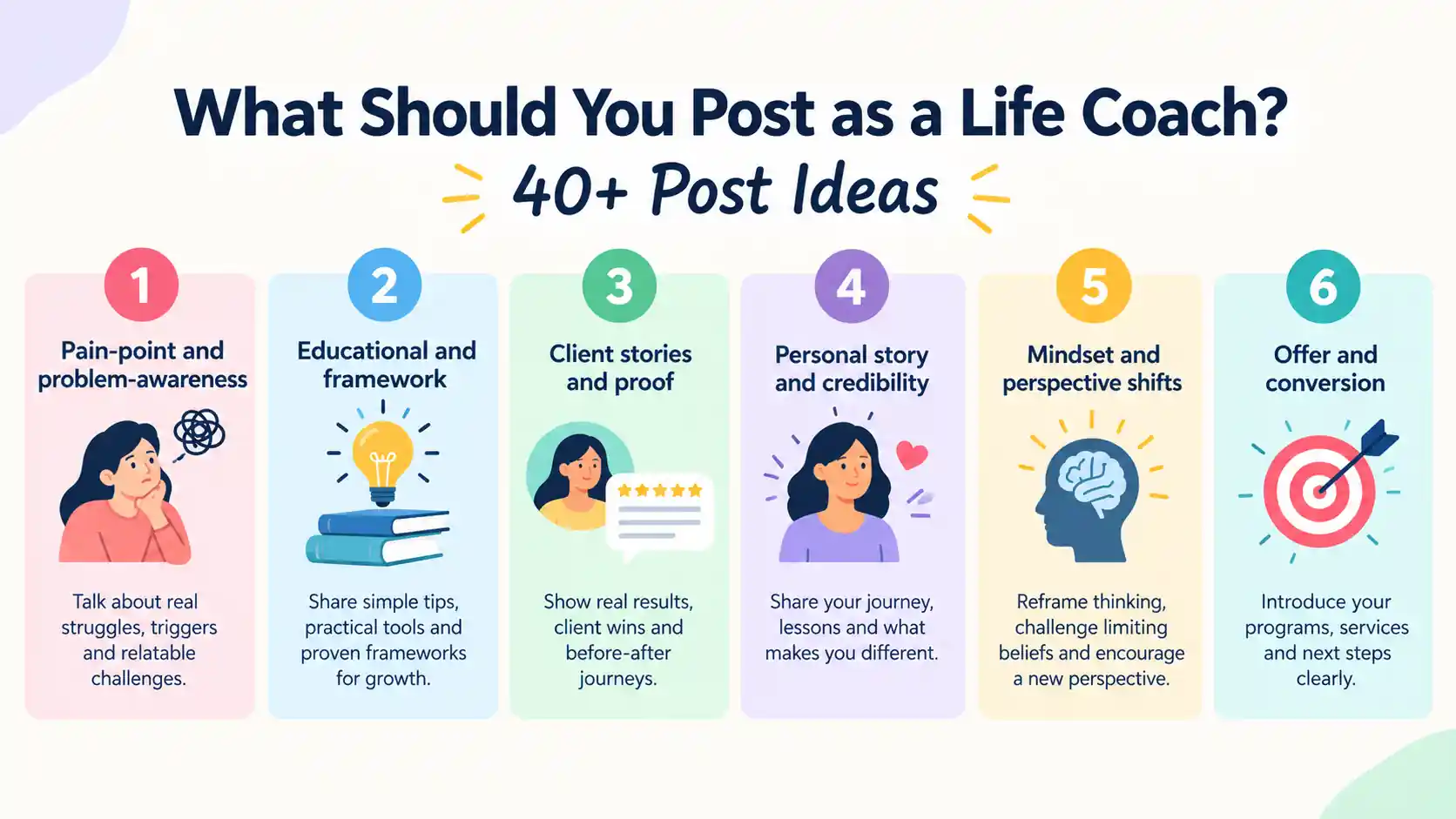
The 6 content pillars every coach needs
Content pillars give you clear ideas about what to post, so you don't have to struggle to come up with something new every time. Every post you publish fits one of these six:
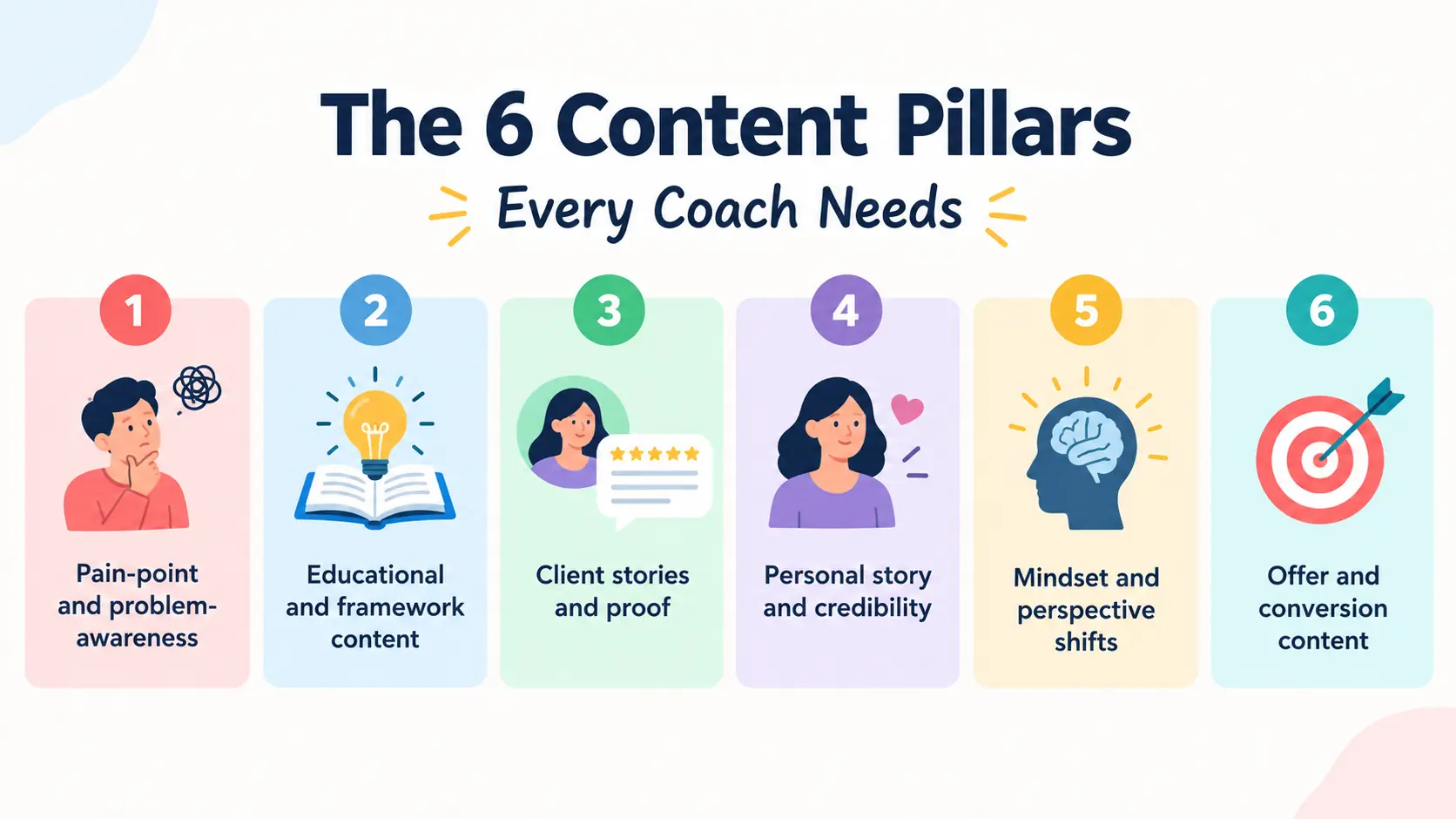
- Pain-point and problem-awareness: name the struggle so people feel seen.
- Educational and framework content: teach one small, useful thing and show how you think.
- Client stories and proof: case studies, testimonials and milestones.
- Personal story and credibility: share why you became a coach, your own experiences and the lessons you've learned along the way.
- Mindset and perspective shifts: reframes that change how someone sees their situation.
- Offer and conversion content: what you sell, who it's for and how to start.
Suggested content mix
A starting point to adjust as you learn what your audience responds to:
| Pillar | Share of posts |
|---|---|
| Educational and framework | 40% |
| Pain-point and problem-awareness | 25% |
| Client stories and proof | 15% |
| Personal story and credibility | 10% |
| Mindset and perspective shifts | 5% |
| Offer and conversion | 5% |
Only 5% of posts are dedicated offer posts, but CTAs appear throughout the others, so you're never invisible.
What should you post as a life coach? 40+ post ideas by pillar
Ideas with example hooks
Pain-point and problem-awareness
- “3 signs you're not lazy, you're stuck.”
- “The thought that shows up at 2 a.m. when you're avoiding this decision.”
- “If you've ever said ‘I'll start on Monday’ more than twice, read this.”
- “The real cost of waiting another year.”
- “Things nobody tells you about [your client's situation].”
- A short scene describing a day in the life of the problem.
- “Why advice from friends isn't helping (and it's not their fault).”
Educational and framework
- Your core framework explained step by step in a carousel.
- “The 5-minute reset I give every new client.”
- “The biggest mistake with [topic] and the simple fix.”
- A walkthrough of a worksheet or tool you use in sessions.
- “3 questions to ask before you [make the decision].”
- “What [common term] really means in practice.”
- “One thing to stop doing this week.”
Client stories and proof
- A before-and-after of a client's thinking, not just their results.
- A kind message from a client (with permission).
- “What changed for her in week three.”
- An anonymised session story with identifying details removed.
- A typical-results summary, honestly worded.
- A client Q&A about what working with you is like.
- A milestone spotlight: a client's first small win.
Personal story and credibility
- Why you became a coach.
- A mistake you made and what it taught you.
- Your own turning point.
- A value you refuse to compromise on.
- What you're learning, reading, or training in right now.
- A day in your coaching life.
- “What I charge for and why.”
Mindset and perspective shifts
- “Rest isn't quitting. Here's the difference.”
- One question to ask yourself today.
- A popular quote you disagree with and why.
- “Progress looks boring from the inside.”
- The identity shift behind the habit.
- A weekly intention your audience can borrow.
- “What if the problem isn't motivation?”
Offer and conversion
- Who your program is for and who it isn't.
- What a typical week inside your program looks like.
- Answers to the five questions you hear most before people book.
- “I have three spots open. Here's how to know if one is yours.”
- The story of how a free call led to a first session.
- An invitation to a free workshop or live Q&A.
- A plain explanation of your pricing and what's included.
Quick formats: Myths vs. truths, “what I'd tell my client,” mini-audits, client wins and behind-the-scenes sessions
These formats work with any idea above:
- Myths vs. truths: a two-slide carousel. Slide one states the myth, slide two corrects it.
- “What I'd tell my client”: a short video where you answer a common client question, just like you're talking to them face-to-face.
- Mini-audits: three yes/no questions in your Stories so people can score themselves.
- Client wins: a quote card with one line of context, shared with permission.
- Behind-the-scenes sessions: a raw photo of your notes, workspace, or session prep with a short caption on what you're thinking about.
What are the best social media platforms for coaches?
Choosing platforms by coaching type
There's no single best platform. The best one is where your clients already spend time and where you can show up consistently.
| Coaching type | Strong starting platforms | Why |
|---|---|---|
| Life coaching | Instagram, Facebook groups | Personal stories and community fit these formats |
| Business coaching | LinkedIn, Instagram | Founders and managers research and network here |
| Health and wellness coaching | Instagram, TikTok, YouTube Shorts | Visual, short, routine-based content travels well |
| Executive coaching | Senior buyers use it for professional credibility | |
| Career coaching | LinkedIn, Instagram or TikTok | Job-seekers and career-changers are active on all three |
Start with one platform for 90 days. Add a second only after you have a rhythm you can keep.
Instagram, LinkedIn, Facebook, TikTok and YouTube Shorts: What to post on each
- Instagram: carousels that teach, Reels with one clear idea, Stories for polls, mini-audits and day-to-day connection.
- LinkedIn: text posts built around a lesson or story, document carousels and thoughtful comments on other people's posts.
- Facebook: share posts in groups, ask questions, host live Q&A sessions and invite people to your workshops.
- TikTok: 30 to 60 second talking videos answering one question, plus quick reframes and relatable scenes.
- YouTube Shorts: the same short answers as TikTok, plus snippets from longer trainings that point people to your full videos.
Comparison table and how to repurpose one idea across platforms
| Platform | Best for | Main formats | Effort |
|---|---|---|---|
| Community and visual storytelling | Carousels, Reels, Stories | Medium | |
| Professional and B2B coaching | Text posts, document carousels | Low to medium | |
| Groups and live events | Group posts, Lives | Low | |
| TikTok | Reach to new audiences | Short talking videos | Medium to high |
| YouTube Shorts | Long-term discoverability | Short clips | Medium |
You don't need five ideas for five platforms. Take one idea and reshape it:
- Record a 45-second video answering one question (Instagram Reel, TikTok, YouTube Short).
- Turn the three key points into a five-slide carousel (Instagram, LinkedIn).
- Write the story behind the answer as a short text post (LinkedIn, Facebook).
- Ask a related question as a poll in your Stories or group.
A content marketing system for coaches
Batching, scheduling and repurposing
A system beats willpower. Here's a simple one:
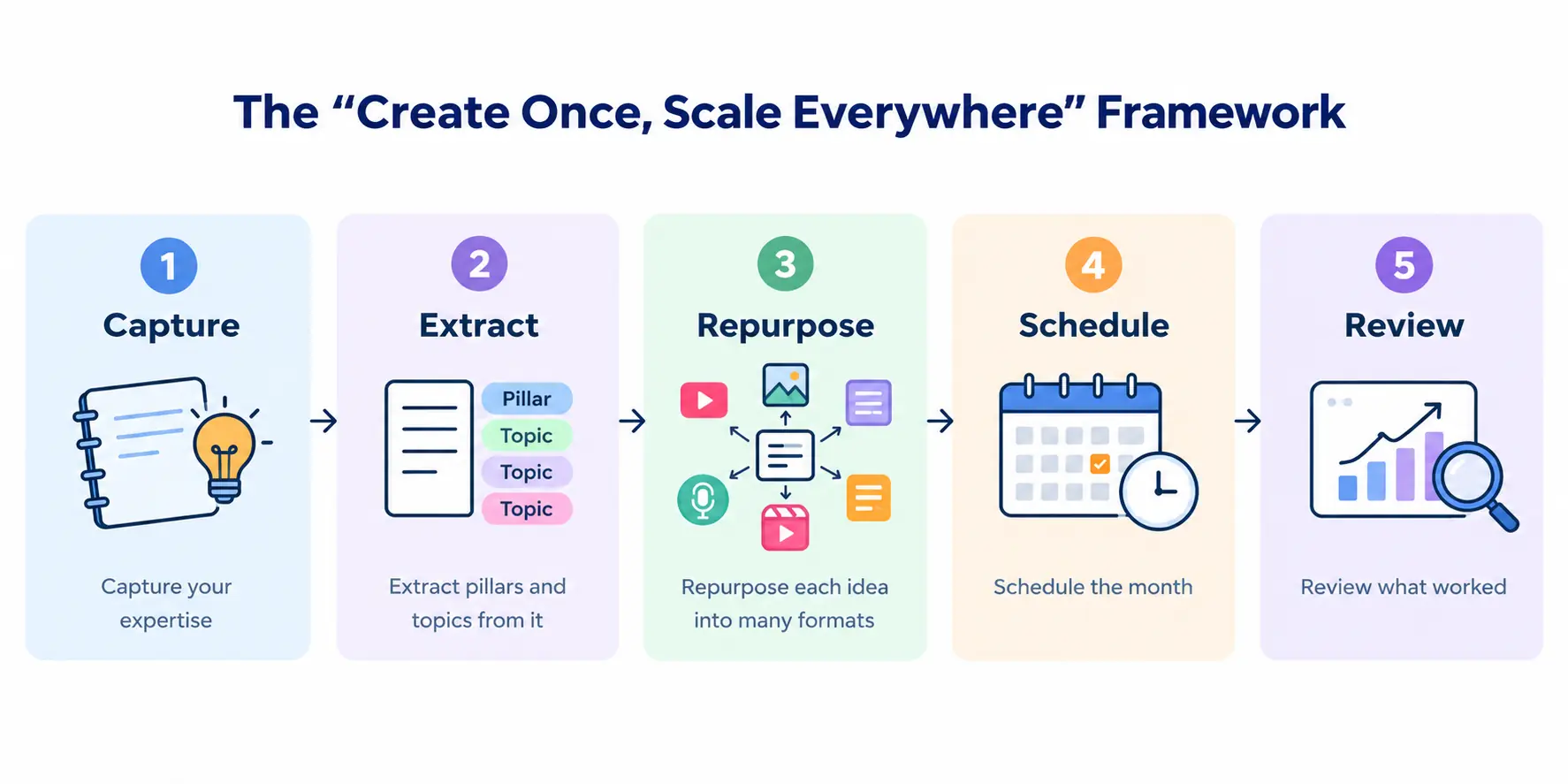
- Weekly two-hour batch: 30 minutes picking ideas from your pillars, 60 minutes creating, 30 minutes scheduling.
- An idea bank: one note where you drop client questions, session themes and things you wish people understood. This is your best source of content.
- One core piece, many posts: a workshop, a newsletter, or a session theme can become six to eight posts.
- Live time: save 15 minutes a day to reply to comments and messages, because that's where clients appear.
Using AI tools without losing your voice
AI can save hours, but only if you stay in charge of what makes you sound like you.
- Give it your raw material: voice notes, client questions, your own phrases.
- Let it draft structure and options: then rewrite in your words.
- Keep stories, results and opinions human: add your own example to every post.
- Read it aloud: if you wouldn't say it to a client, change it.
For a deeper look at building an AI-assisted workflow, read our companion guide, The Coach's Guide to AI Content.
Weekly coaching content and 30-day plan
A plan turns social media management for coaches from a daily guessing game into a routine you can run on a busy week.
Posting frequency by stage (solo vs. established)
- Solo or just starting: three feed posts a week, plus Stories on the days you can.
- Established, or with a team: four to five posts a week.
The research gives a range rather than one magic number. Buffer's analysis of more than 2 million Instagram posts found that posting three to five times a week more than doubled follower growth compared with one or two posts. Its LinkedIn study of 2 million posts from 94,000+ accounts found that each step up in frequency gave stronger per-post results. Hootsuite's 2026 analysis, on the other hand, found per-post engagement rate peaks around two posts a week on Instagram, Facebook and LinkedIn. These studies measure different things (growth versus engagement per post), so use them as a range. The best frequency for any coach social media strategy is the one you can keep up for six months.
Weekly rhythm: Educate, prove, connect, sell
| Day | Purpose | What to post |
|---|---|---|
| Monday | Educate | A carousel or Reel teaching one idea |
| Wednesday | Prove | A client story, milestone, or typical-results post |
| Friday | Connect | A personal story or a question for your audience |
| Most days | Stories | Polls, question boxes, quick thoughts |
| Every week or two | Sell | Swap one slot for an offer post with a direct CTA |
30-day plan
| Week | Focus | Pillars to lean on |
|---|---|---|
| 1 | Clarity: make the problem visible | Problem-awareness, personal story |
| 2 | Teach: share your framework and quick wins | Educational, mindset |
| 3 | Prove: show how people change | Client stories, proof |
| 4 | Invite: open the door to a call | Offer, FAQs, then a monthly review |
Worked example: A four-week coaching cohort launch
Here's how the system looks in practice. This is a hypothetical example: a career coach opening eight seats in a six-week cohort for first-time managers. The goal is not likes. It's booked discovery calls. It's also a good model for social media for life coaches who run group programs.
Week-by-week plan: Warm-up, launch, objections, close
- Week 1, warm-up: make the problem unmissable. Publish problem-awareness and personal-story posts and start DM conversations from Story replies.
- Week 2, launch: announce dates, who it's for and who it isn't for. Invite people to a free mini workshop to warm them up.
- Week 3, objections: answer the three doubts you hear most (time, money, “will it work for me?”). Start with one post for each and include real examples to support your points.
- Week 4, close: share honest remaining spots, a real deadline and a last-call story. Follow up personally in DMs.
Sample posts for each week
Week 1: “Most new managers admit the same thing in our first call: ‘I don't know what I'm doing.’ You're not behind. You're new. Here are five signs you're managing by panic and what to do instead.”
Week 2: “Doors are open. Eight seats, six weeks, one goal: help first-time managers lead without burning out. Starts [date]. Comment LEAD and I'll send the full details.”
Week 3: “I know joining a program can feel like one more thing to fit into your busy schedule. I understand. It's usually the sign you need one. Here's how the six weeks fit around a full workload: 45 minutes live and 15 minutes of practice each week.”
Week 4: “Four seats left. If you've been ‘thinking about it,’ book a 20-minute call this week. If it's not a fit, I'll tell you. Registration closes Friday.”
Only use deadlines and seat counts that are true. Fake scarcity costs more trust than it earns.
Copy-paste templates, caption formulas and Instagram Story ideas
Post and DM templates
Teaching post
Most people think [common belief]. Here's what I see instead: [your insight]. Try this today: [one small action]. Save this for later and tell me how it goes.
Client story post
When [client type] first came to me, they felt [before]. We worked on [bridge]. Now they [after]. If you see yourself in this, send me a message.
Offer post
I'm opening [number] spots for [program name]. It's for [who] who want [outcome]. It's not for [who it isn't for]. Message me [keyword] and I'll send you the details.
DM after a comment
Thanks for sharing that, [name]. What made this one hit home for you?
DM after a freebie download
Hi [name], hope the [resource] is useful. Which part do you want to tackle first?
DM follow-up after a call
It was great talking, [name]. No pressure at all. If you have questions before you decide, I'm happy to answer them here.
6 caption formulas
- Problem, agitate, solve: name the problem, show what it costs, offer your approach.
- Before, after, bridge: describe the stuck state, the better state, then how to get there.
- Story, lesson, ask: tell a short moment, state the takeaway, invite a reply.
- Hook, steps, CTA: a bold first line, three to five numbered steps, one clear next move.
- Question, answer, invite: start with something your clients ask, answer it plainly, offer to go deeper.
- One thought: share one useful idea and end with a question that makes people think.
Story sequences that lead to a call
- This-or-that poll: two options about a common struggle, a frame sharing what the result says, then an invitation to reply with their answer.
- Question box: ask, “What do you struggle with most when it comes to [topic]?” Answer three replies in your own words, then offer a helpful guide to those who respond.
- Mini story arc: the problem, the turning point, then an invitation with a link sticker to book a call.
Mindset shifts for marketing success
1. Visibility without feeling salesy
People need to know about you before they can hire you. Being visible isn't pushing yourself on others. It's making it easy for the people who need help to find it. If you're nervous about being seen, remind yourself who is waiting on the other side of your post.
2. Selling as service
A sales conversation is a diagnosis. You listen, ask good questions and decide together whether coaching is the right next step. Sometimes the honest answer is “not yet” or “not me.” Coaches who sell this way earn referrals even from people who never book.
3. Consistency over perfection
Posting something good beats waiting until it's perfect. Set a minimum standard (it teaches, comforts, or invites) and ship at that standard. The strongest coach social media strategy is the one you can run on a bad week.
Tools to simplify social media marketing for coaches
- Scheduling: native schedulers on Meta and LinkedIn are free. Third-party tools range from about $5 per channel a month to about $99 per user, based on published entry prices in mid-2026.
- Design: a template-based design tool is enough. Choose two fonts and three colors, then reuse them so your content looks like you.
- Analytics: each platform's built-in insights are enough at the start. Add a simple spreadsheet to track posts, saves, DMs and calls booked.
Where PostEverywhere fits for coaches
If you publish on three or more platforms, a scheduling tool such as PostEverywhere helps you queue the reshaped versions of one idea in one place. If you're only active on one platform, the native scheduler is enough. Check current features and pricing on the tool's website before you commit.
Hiring help: Social media management services for coaches
Hire when
- You know what you're offering and have results to show, but you're short on time
- Your posting stops whenever client work gets busy
- You spend five or more hours a week on content
- You want to grow beyond one platform
DIY when
- You're still testing your niche or offer
- You have no client results yet
- Budget is tight and learning the basics first will make any future hire more effective
Top-rated social media management services for life coaches
We can't hand you a universal ranking and be wary of anyone who does. Instead, here's what the best services for social media for life coaches have in common:
- They understand transformation selling, not just posting
- They first plan what to say and how to stand out, then decide what to post
- They can show verifiable results for coaches or similar service businesses
- They match your voice and let you approve anything involving proof or client stories
- They report on calls and enquiries, not just followers
At Sociyell, social media growth and management is an end-to-end service: we plan, produce, publish and optimize your content using Gen-AI to turn what you already have (photos, clips, ideas) into a steady content engine. We work with coaches most of the time.
Where to hire experts who specialize in coaching businesses
- Referrals: ask coaches whose content you admire who runs it. This is the strongest source.
- Coaching communities and masterminds: often have lists of trusted service providers.
- Agencies and studios: check their portfolios for coaching or service-brand work.
- Freelancers: search LinkedIn for “social media manager for coaches” and ask for coaching samples.
- Freelance marketplaces and virtual assistants: best for lower budgets and basic scheduling, with more vetting needed.
What to delegate vs. keep, what to ask, pricing ranges and red flags
Delegate: scheduling, design, repurposing, first-pass community replies and reporting.
Keep: your stories, your opinions, important client conversations and final approval on proof and claims.
Ask before you sign:
- Which coaches or service brands have you worked with?
- How will you learn my voice?
- What updates will you share and how often?
- Who owns the accounts and the content?
Pricing ranges: published 2026 guides from Sprout Social and WebFX put professionally managed social media at roughly $500 to $5,000 a month. Agency fees often exclude ad spend, so ask what's included.
Red flags:
- Guaranteed followers or guaranteed clients
- Purchased followers or engagement
- No coaching or service-business samples
- Generic templates with no strategy
- Asking for your password instead of using proper access roles
Measuring coaching social media: Discovery calls, not followers
1. Vanity vs. business metrics
Followers and likes feel good, but they don't pay your rent. Business metrics are the ones tied to conversations and calls: DMs from right-fit people, discovery calls booked and clients signed. Any coach social media strategy should be judged by those.
2. Saves, shares, DMs, calls booked and cost per lead
- Saves: people find your post insightful and want to read it again later.
- Shares: your message is worth passing on, often a sign of new reach.
- DMs: people are ready to talk.
- Calls booked: the metric that matters most.
- Cost per lead: your time plus any spend, divided by the number of enquiries. Even a rough number shows whether the work is paying off.
3. Monthly review checklist
- How many calls were booked and from which posts or platforms?
- Which three posts drove the most saves, shares, or DMs?
- Which pillar performed best and which went quiet?
- Which CTA drew replies?
- What did people ask in comments that could become new content?
- What will you do more of next month and what will you do less of?
Mistakes coaches make on social media
- Motivational quotes only. Quotes are easy to scroll past and don't show your method. Share your thinking instead.
- Teaching without inviting. Great content with no next step leaves people impressed but not booked. Add a soft CTA to most posts.
- Hiding the offer. If nobody can tell what you sell, nobody buys it. Say it plainly and regularly.
- Inconsistent messaging. Changing your niche every month confuses the algorithm and your audience. Stick with one transformation long enough to be known for it.
- Overpromising. Big promises attract the wrong clients and invite legal trouble, as the next section explains.
Managing social media well means knowing what not to do, not just what to post.
Social media guidelines for coaches: Confidentiality, testimonials and claims
1. Client confidentiality and permission for case studies
Professional coaching codes, including the ICF's, treat client confidentiality as a core duty. Get written permission before you share any client's words, results, or image. When in doubt, anonymise by changing details, or tell the story in general terms. Never share anything from a session without clear consent.
2. Income and result claims, health and mental-health boundaries
Results and income. The FTC's Endorsement Guides no longer treat a line like “results not typical” as a safe harbor. If a testimonial shows an unusual result, you're expected to be able to back up what clients can typically expect and to say so clearly. In practice: share real results, give honest context and avoid earnings promises you can't document.
Health and mental health. Coaching isn't therapy. Avoid language that suggests you diagnose, treat, or cure anything and refer clients to a licensed professional when something goes beyond coaching.
This is general guidance, not legal advice. The rules are different in each country, so make sure you know which ones apply to you and your clients.
Conclusion
You don't need to post every day, go viral, or sound like everyone else. You need a clear transformation, content that shows before, bridge and after, a rhythm you can keep and a simple path from post to conversation to call. That's what makes social media management for coaches work.
Here's one action for today: write your positioning statement, then schedule your next three posts using the 30-day plan.
If you'd rather have a team build and run the system for you, take a look at Sociyell's social media growth and management service. We'll help you turn what you already have into content that keeps your coaching business visible while you focus on your clients. Want us to do this for you? Talk to Sociyell.
Frequently asked questions
What is social media marketing for coaches?
It's using social platforms to attract the right audience, build trust and turn conversations into discovery calls.
What can coaches share on social media?
A mix of teaching, problem-awareness, client proof, personal stories, mindset reframes and offers. The 40+ ideas in this guide are grouped by pillar, making it easier to decide what to post.
How do online coaches get clients?
Through a path: content builds attention and trust, a comment or DM starts a conversation and a short discovery call decides fit.
How can you promote your coaching business on social media?
Be clear about how you help people, focus on one or two platforms, post regularly, reply to comments and messages and guide interested people on what to do next. Then review monthly.
Which is the best social media platform for coaching?
The one where your clients already are and where you can stay regular. LinkedIn suits business and executive coaches, while Instagram suits many life and wellness coaches.
How often should a coach post?
Start with three posts a week and build from there. Studies disagree on the ideal number, so choose a pace you can sustain.
Where can I find someone to manage social media for my coaching business?
Start with referrals from other coaches, then look at agencies, specialist freelancers and coaching communities. Sociyell's social media growth and management service is built for coaches and service brands.
How do you show transformation without client results yet?
Show your method, your own story and your thinking. Offer a founding-client spot, with permission, to earn your first real story. Never invent results.