
LLMO (Large Language Model Optimization) is the process of making a brand’s content easier for AI systems to understand, trust and potentially reference in their answers. In simple terms, it helps brands become more visible when people search for information through AI tools instead of traditional search engines.Think about what happens when someone asks ChatGPT, Gemini, Perplexity or Claude about a product, service or company. The AI needs to understand different sources, connect the information and decide what is useful for its answer. LLMO helps a brand create the kind of clear, useful and credible content that gives these systems better information to work with.Unlike traditional SEO, which mainly focuses on search rankings, LLMO focuses on AI visibility and the possibility of being mentioned or cited in AI-generated answers. That does not make SEO less important - it simply means brands now need to think beyond the traditional search results page.
Why AI Search Optimization Matters in 2026
People are increasingly turning to AI tools to find information, evaluate choices and decide what to do next. Pew Research Center’s 2026 survey found that 49% of U.S. adults have used AI chatbots, while 42% use them to search for information.
Pew Research Center also found that 58% of respondents in a March 2025 browsing-data study conducted at least one Google search that produced an AI-generated summary. The study analyzed browsing activity from 900 U.S. adults, showing how AI-generated answers are becoming part of traditional search experiences.
For brands, that means visibility is no longer limited to Google’s SERPs. Content also needs to be clear, credible and easy for AI systems to understand and refer.
In simple terms, LLMO helps brands prepare their content for the way people are increasingly searching and getting answers online.
How LLMs Find and Cite Your Brand
AI search optimization is not just about creating content and hoping an AI mentions your brand. LLMs find and cite brands mainly through two pathways: training data and real-time retrieval through systems such as RAG. Understanding both helps a brand build stronger AI visibility.
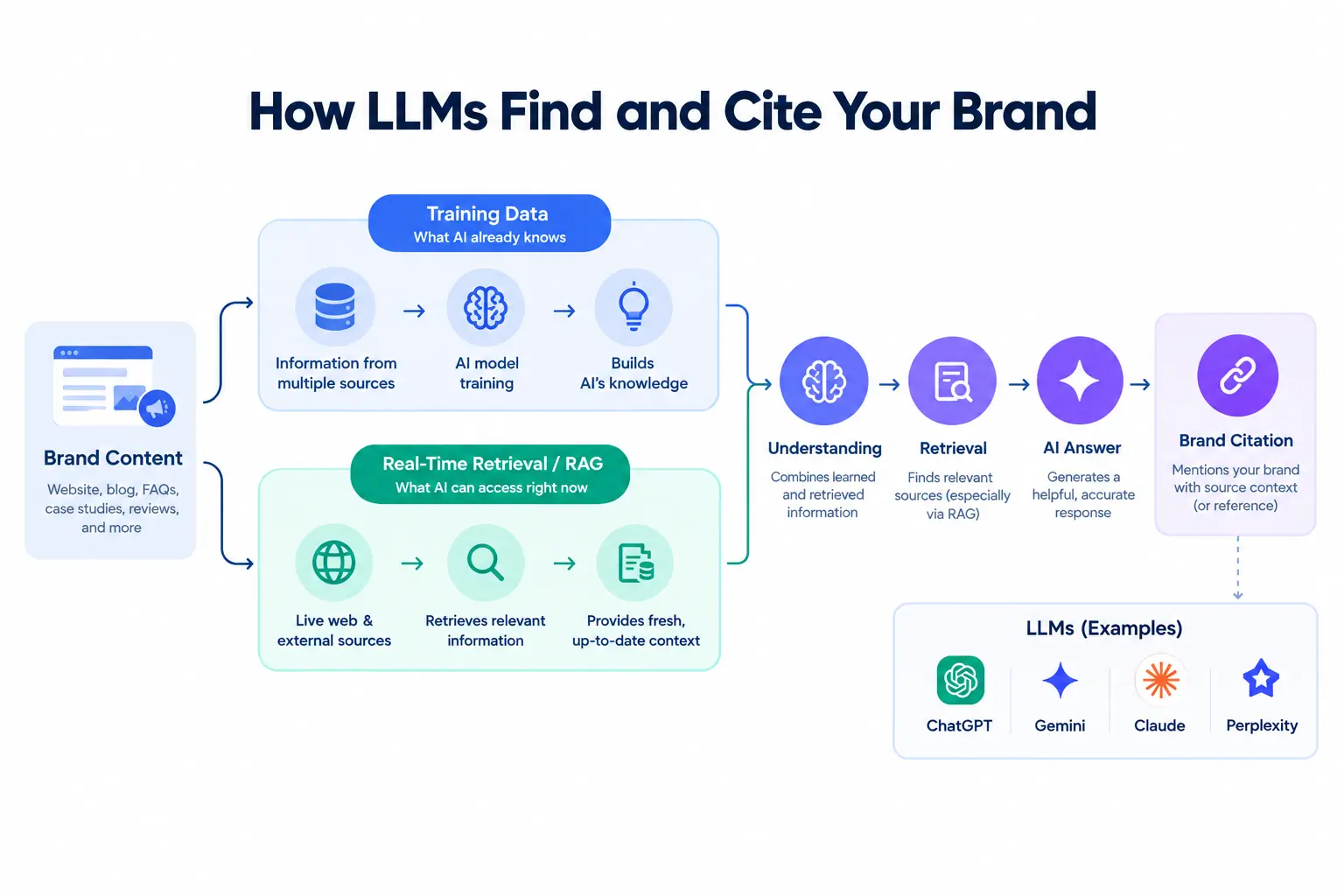
AI search optimization is not just about creating content and hoping an AI mentions your brand. LLMs find and cite brands mainly through two pathways: training data and real-time retrieval through systems such as RAG. Understanding both helps a brand build stronger AI visibility.
Pathway 1: Training Data
Think of training data as what an AI has already learned. Before an AI model answers questions, it has been trained on large amounts of information from different sources. If a brand, product, or company is consistently discussed across reliable websites and other sources, that information can contribute to what the model knows about it.
You can think about this as reputation. The more consistently a brand appears with useful and credible information, the stronger its overall presence can become in the information an AI has learned from.
However, training data is not the only way AI systems find information.
Pathway 2: Real-Time Retrieval with RAG
RAG (Retrieval-Augmented Generation) allows an AI system to retrieve information from external sources and use it to generate an answer. In simple terms, it works like a live search: instead of relying only on information already available to the model, the system can retrieve relevant information when a user asks a question.When RAG is involved, AI systems can access relevant information available online before generating a response. This makes a brand’s current website content, service pages, expert articles and other credible online information important. Clear, accurate and well-structured information gives AI systems better material to understand what a brand does.
For example, if someone asks an AI platform for recommendations for a specific service, the system may retrieve relevant information from websites and other sources before forming its answer. If a brand’s information is clear and accessible, it has a better opportunity to be considered in that response.
This matters when a brand wants to get mentioned by ChatGPT or appear in AI-generated answers. ChatGPT, Gemini, Perplexity and Claude may use different retrieval systems and sources, but the principle remains similar: relevant and credible information needs to be discoverable when the AI system looks for it.
For brands, this means keeping important information accurate, up to date and easy for AI systems to access.
LLMO vs. SEO: What’s Actually Different?
SEO focuses on search visibility, while LLMO extends that visibility into AI-generated answers. Traditional SEO helps a brand appear higher in search rankings, while LLMO helps make that brand understandable, discoverable and referenceable across AI platforms.
The important part is that SEO and LLMO are connected, not competing strategies. Many of the things that make a website strong for search: useful content, clear structure, technical accessibility and authority also give AI systems better information to work with.
The main difference comes down to where the visibility appears and how success is measured. The comparison below makes this distinction clearer:
A strong LLMO strategy can build on the SEO work a brand is already doing. Technical SEO, structured content, schema, E-E-A-T and authority signals can all contribute to a stronger foundation for AI visibility.
Think of it this way: SEO helps people find your brand through search, while LLMO helps AI systems understand and reference your brand when generating answers. The two work better together because a brand needs to be discoverable, understandable and credible across both environments.
Where GEO and AEO Fit In
You may also come across generative engine optimization (GEO) and Answer Engine Optimization (AEO). These terms overlap with LLMO, but they are not exactly interchangeable.
GEO generally focuses on visibility in generative search experiences, while AEO focuses on helping content appear in direct answers. LLMO takes a broader model-focused approach, helping large language models understand and reference a brand.
So, the goal is not to replace one approach with another. Traditional search still matters, AI answer engines are growing and brands need visibility across both. The real opportunity is to build an SEO foundation and extend it into AI search.
Want to know where your brand stands in AI search? Sociyell runs a free LLMO visibility audit. Get yours
How to Rank in AI Answers
Knowing how AI finds information is useful, but the next question is practical: how to rank in AI answers? The answer starts with making your content easy to access, understand, verify and retrieve.
If you want to optimize for AI search, start with the basics. AI visibility is not about adding a few technical tricks to a website. It is about creating useful content, keeping important information accessible and giving AI systems enough context to understand what your brand actually knows.
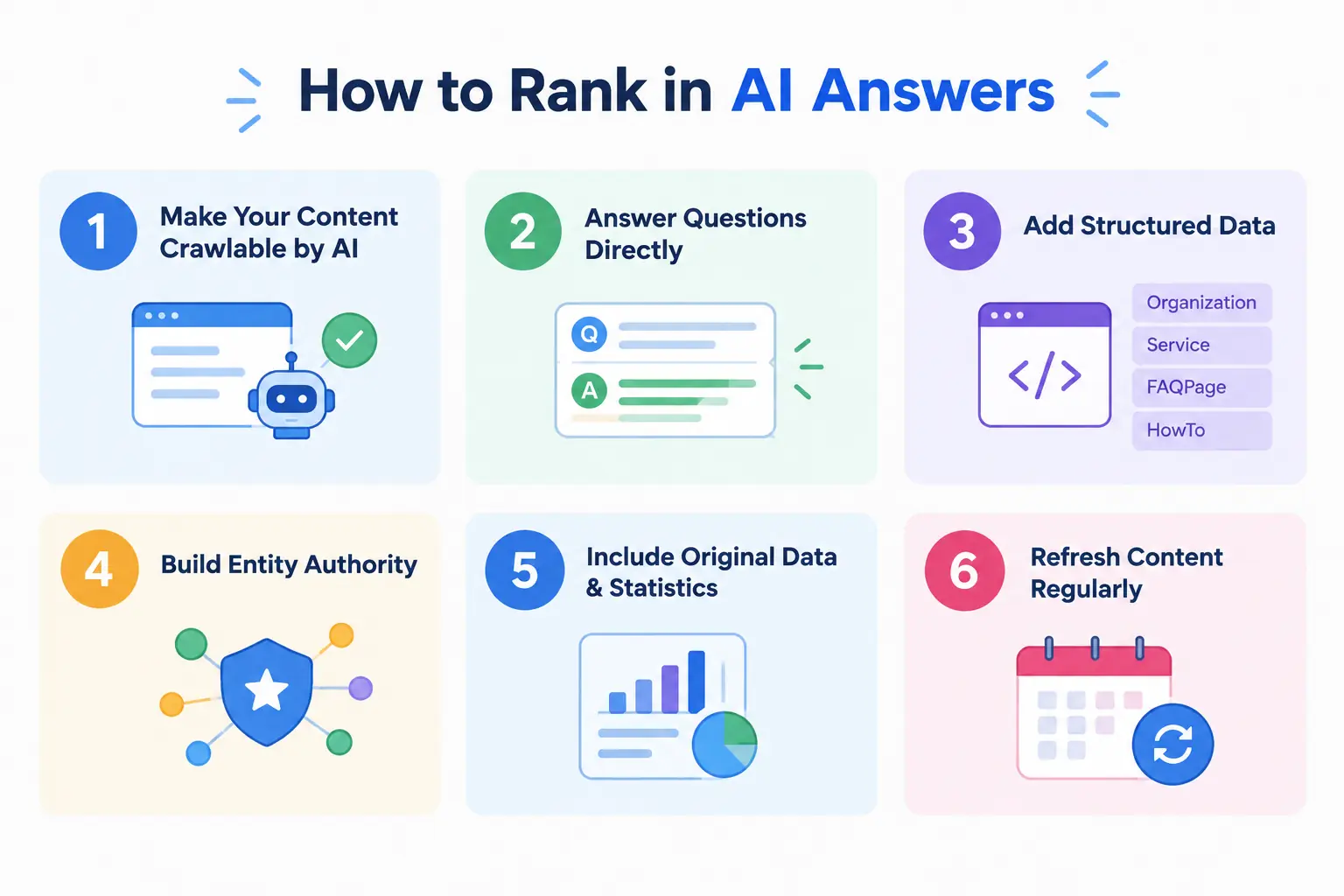
These six steps give brands a practical foundation to start with.
1. Make Your Content Crawlable by AI
Start by making sure important pages can actually be accessed and crawled. Check your robots.txt file and make sure it is not accidentally blocking pages that contain valuable content.
For instance, check whether your robots.txt file blocks or other important paths containing articles, resources or product information. Also, avoid keeping essential information available only after heavy JavaScript execution. Google recommends making important content available in text and ensuring pages can be crawled and indexed.
A quick check can help here. Test your important pages with Google's Rich Results Test and review how search engine sees the page. Server-side rendering can also help deliver the main content without depending entirely on client-side JavaScript.
2. Answer Questions Directly in the First 2 Sentences
Give the answer first, then explain it. When someone searches for a specific question, they should not have to read four paragraphs before finding the actual answer.
For example, instead of starting with:
“AI search has evolved considerably over the last few years...”
Start with:
“LLMO helps optimize a brand’s content so AI systems can understand, retrieve and potentially cite it.”
Then follow that answer with supporting evidence, examples and context. This structure also makes each section easier to understand on its own.
A simple format works well: direct answer → supporting evidence → example. It keeps the content useful for readers while making the main point clear from the beginning.
3. Add Structured Data (Schema Markup)
Use structured data to give search engines additional context about what a page contains. Think of it as adding labels to your content so machines can better understand the information on the page.
For example, an organization page can use Organization schema, a service page can use Service schema and relevant FAQ content can use FAQ Page schema where applicable. Google describes structured data as a standardized way to classify information on a page.
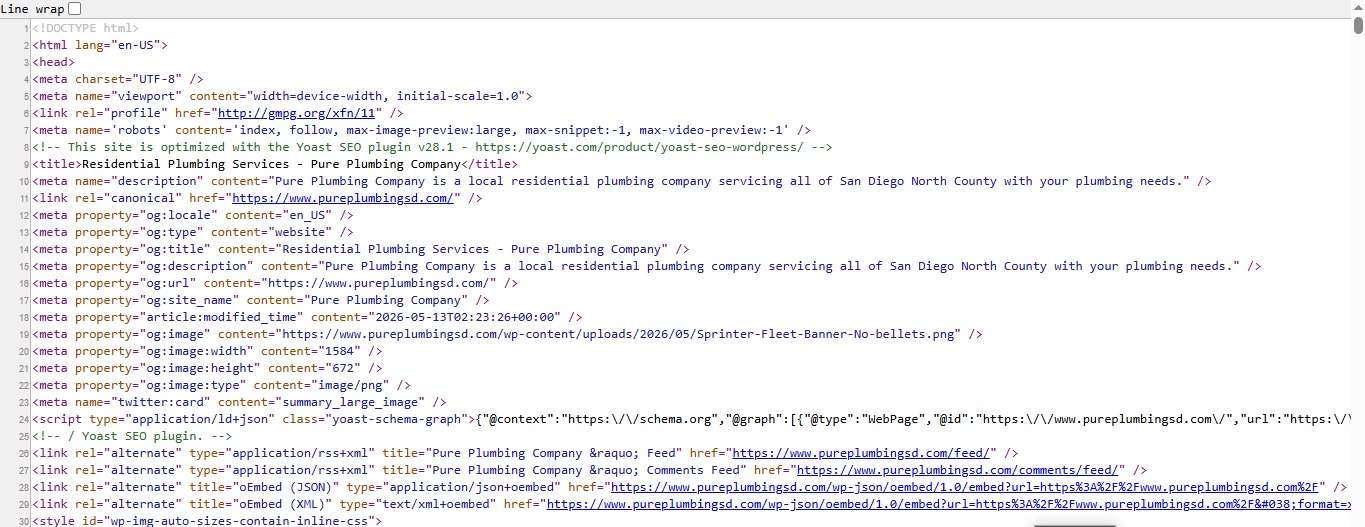
You may see schema markup written in a format such as JSON-LD inside a webpage. You do not need to understand all the code to use it effectively - the important part is that the markup accurately represents the visible content.
Before publishing, validate the implementation using Google's Rich Results Test and fix any important errors. Structured data can help search engines understand a page, but it does not guarantee a particular search appearance or AI citation.
4. Build Entity Authority
Make your brand easy to understand by building consistent information around it across trustworthy sources. This is where entity optimization, co-citation and consistent brand information become important.
Think about how someone would describe your brand if they had to explain it in one sentence. If your website says one thing, your social profiles say another and third-party sources describe you differently, there is less consistent context available.
The goal is not to collect random mentions. It is to build genuine content authority and topical authority around what your brand actually does.
5. Include Original Data and Statistics
Give your content something more useful than opinions. Original research, surveys, case studies, experiments and properly attributed statistics can make a piece of content more valuable and easier to reference.
A good example comes from the original GEO research. The study tested different content optimization methods and reported visibility improvements of up to 40% in its generative-engine benchmark. The results varied depending on the domain and optimization method.
This is the kind of data that strengthens an explanation because the reader can see where the number came from. Search Engine Land also reported on the research, noting that adding relevant statistics, quotations and citations could improve visibility by up to 40% in the study's testing.
6. Refresh Your Content Regularly
Do not publish an important page once and forget about it. Review key content regularly and update anything that has become outdated, especially statistics, examples, product information, links and industry developments.
For example, if an article says “the latest AI search statistics” but the numbers are two years old, the page can quickly lose its usefulness. A quarterly review gives the team a simple opportunity to check whether the information is still accurate and relevant.
That does not mean every page needs to be rewritten every three months. Update content when there is something meaningful to improve. Freshness should come from keeping information useful and accurate, not from changing a few words just to show a new date.
A Quick Note on LLMs.txt
You may also come across LLMs.txt, a proposed file designed to provide AI systems with a cleaner overview of a website's important content.
It is worth knowing about, but it should not be treated as a magic switch for AI visibility. Google currently says that LLMs.txt is not required for appearing in Google Search or its generative AI features and Google Search does not use it for those features.
If a particular AI platform or service chooses to support the format, it may have its own use case. For now, brands should focus first on the fundamentals: accessible content, clear answers, strong authority, accurate information and solid SEO foundations.
LLM Citation Hack
Treat every numbered step as a standalone answer. A reader should be able to understand the point without reading the sections before it.
The same principle makes the content easier to refer. Direct answer → evidence → example gives each section a clear beginning, useful context and a reason to trust the information.
That is the practical side of LLM optimization for brands. It is less about trying to “hack” an AI system and more about building a website and online presence that clearly demonstrate what the brand knows and why that information is worth referencing.
Need help implementing these steps? Our SEO & LLMO services handle the entire process. See how it works.
LLM Optimization for Brands: What It Actually Means
LLM optimization for brands means making a brand easier for AI systems to understand, trust and mention when people ask relevant questions. For a business owner, the key question is simple: Will my brand appear when someone asks ChatGPT for a recommendation?
Imagine someone asks:
“What are the best AI content agencies for D2C brands?”
If a relevant brand does not appear in the answer, there is a visibility gap. The brand may have a strong website, useful content and solid traditional SEO, but AI visibility is becoming another way people discover businesses.
This is where an LLMO service can help. Instead of focusing only on rankings and website traffic, LLMO looks at how a brand is represented across AI answer engines. It considers whether the brand has clear information, consistent mentions, relevant authority signals and content that supports accurate AI-generated answers.
For example, if Sociyell is consistently mentioned alongside terms such as LLMO, AI content production and AI search across relevant third-party sources, these associations can help reinforce how the brand is understood as an entity.
In practice, a brand may publish detailed service pages, build topical authority, maintain consistent business information and strengthen its presence across relevant digital channels. This can include AI content production, social media growth and management and consistent branding and identity.
The goal is not to manipulate AI into mentioning a brand. It is to build a clear, authoritative digital presence that supports accurate and consistent brand representation.
For brands looking beyond traditional search, LLMO is becoming a practical visibility strategy rather than simply another technical trend.
Frequently asked questions
How to earn AI citations?
To earn AI citations, create clear, direct answers to the questions your audience is likely to ask. Put the main answer within the first 40 to 50 words under a question based heading, then support it with useful details, examples or evidence. This makes your content easier for AI systems to understand and reference.
What are LLM optimization techniques?
The core LLM optimization techniques are making your content crawlable by AI, answering questions directly in the first two sentences, adding structured data, building entity authority with consistent brand information across trusted sources, publishing original data and statistics, and refreshing key content regularly. Together they help AI systems like ChatGPT, Gemini, Perplexity and Claude find, understand, trust and cite your brand.
How long does LLMO take to show results?
LLMO results can vary depending on how AI systems discover and use information. With RAG, a brand may appear in AI answers within weeks when relevant content is retrieved. Building familiarity through training data can take months, so LLMO is an ongoing process rather than a one-time task.
Can LLMO replace traditional SEO?
No, they work together. Traditional SEO still helps brands earn search rankings, organic traffic and authority, while LLMO focuses on visibility in AI-generated answers. Combining SEO and LLMO services gives brands a broader search strategy that covers both traditional search engines and AI answer platforms
How do I know if my brand is being cited by AI?
Start with Google Search Console to see if your website appears in Google’s AI Overviews and AI Mode. Just remember, GSC only covers Google’s AI experiences, not platforms like ChatGPT, Perplexity or Claude. For those, try real customer-style prompts and see if your brand shows up. Also check how your brand is described and which sources AI uses.GSC mainly shows impressions, so it tells you your site appeared, not necessarily that someone clicked it.
Is ChatGPT an LLM or NLP?
ChatGPT is not NLP itself. It is an AI product built on large language models (LLMs) that use natural language processing to understand and generate responses. In simple terms, NLP is the broader field, while an LLM is a type of model used for language tasks. ChatGPT uses these models to understand prompts and generate human-like responses.
Sociyell: The Agency That Does Both SEO and LLMO
Sociyell, an AI-powered content and growth studio, brings traditional SEO and LLMO together under one roof. The idea is simple: help brands stay visible wherever people are looking for answers - from Traditional search to AI answer engines.
SEO and LLMO work better together than separately. Search rankings, organic visibility, content authority and AI citations are all part of building a strong digital presence. A brand still needs a solid SEO foundation while making its content easier for AI systems to understand and reference.
With its SEO & LLMO service, brands can work on both sides of modern search - from useful content and technical SEO to stronger authority signals and AI visibility. The focus is on building a consistent online presence rather than chasing every new AI trend.
If the goal is to be found by both people and AI, bringing SEO and LLMO together gives brands a more complete approach to online visibility.