

How to get your brand mentioned in AI answers: A practical guide for 2026
Learn how to rank in AI answers and get mentioned by ChatGPT, Gemini and Perplexity. A practical 2026 guide with data, steps and a 90-day plan.
Try this quick test. Open ChatGPT and ask for the best option in your category, the way a real customer would. Now read the answer. Is your brand in it?
If it isn't, don't panic. It doesn't mean your business is weak. It means the way people find brands has quietly changed. SparkToro's 2026 data shows about 68% of US Google searches now end without a click, and clicks drop by nearly 60% whenever an AI Overview appears. People often get what they need without visiting a website, so the brands named in the answer are the ones that stay top of mind.
The good news is that you can improve your chances of being included. Ahrefs found that brand mentions across the web track AI Overview visibility about three times more strongly than backlinks do. So learning how to rank in AI answers is less about tricks and more about becoming a brand that is clearly described, talked about in the right places and easy to trust.
In this guide, we'll walk through how to get mentioned by ChatGPT, appear in AI search results and build a simple AI answer optimization habit, one step at a time. New to the idea? Our primer on what LLMO is is a good place to start.
What does "being mentioned in AI answers" actually mean?
Let's clear this up early, because it saves a lot of confusion later. A mention is simply your brand's name showing up inside an AI-generated answer. Someone might ask, "What's a good tool for this?" and the AI suggests a few brands. If yours is one of them, that counts as a mention.
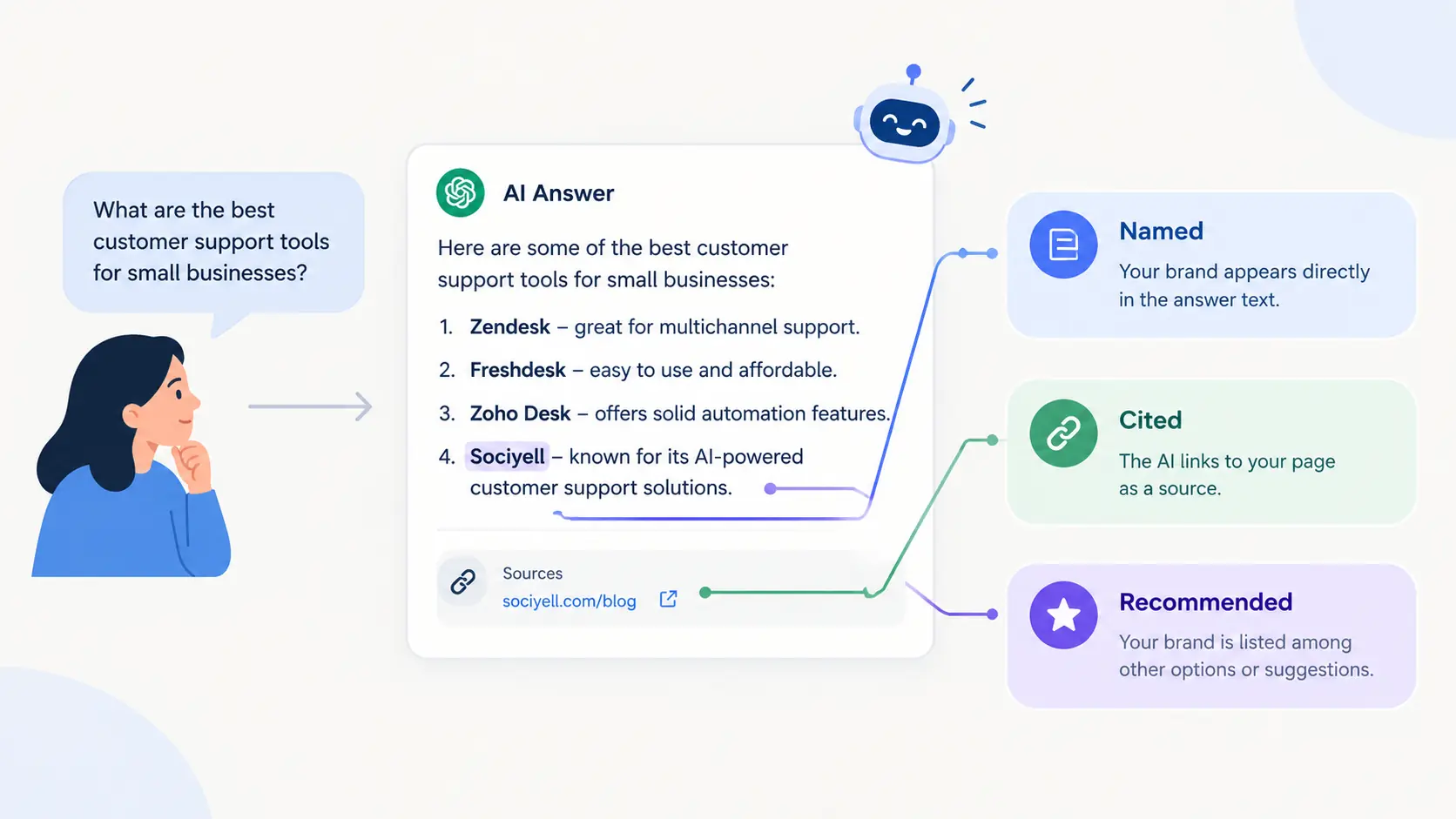
Your brand can appear in AI answers in three different ways:
- Named: Your brand is mentioned directly in the answer.
- Cited: The AI uses your webpage as one of its sources.
- Recommended: The AI suggests your brand as the right fit for that person.
Why does one brand get picked and another get skipped?
It comes down to two things. The first is what the model learned during training, which is basically its memory of your brand. The second is what the AI finds online when it looks for fresh information. If you want your brand to appear in AI answers, you need to work on both.
Here's something many businesses overlook: your own website is only one part of the picture. In some analyses, a brand's own site makes up just 5% to 10% of the sources AI search references. The rest comes from other people talking about you.
GEO vs. SEO vs. AEO: What's different and what still works
If these three acronyms have made your head spin, you're not alone. Most people treat them as three separate jobs. They're really three layers of one job: being found wherever your customer asks a question.
| Basis | SEO | AEO | GEO |
|---|---|---|---|
| Goal | Rank on the results page | Be the direct answer | Be mentioned in AI-written answers |
| Where you show up | Google, Bing | Snippets, voice, answer boxes | ChatGPT, Gemini, Perplexity, Claude |
| Success looks like | Clicks and rankings | Being picked as the answer | Mentions and citations |
Why this matters now
This isn't a future problem. Pew Research found that 49% of U.S. adults have used AI chatbots and 42% use them to search for information. An earlier Pew browsing study found that 58% of participants saw an AI-generated summary on at least one Google search. Your customers are already getting answers before they ever click a link.
What still works
Good news first: your SEO work isn't wasted. Crawlable pages, clean structure, useful content and real authority still feed every AI system. If you want to appear in AI search results, a weak SEO foundation will hold you back.
What's actually new
- Lead with the answer. Put it in the first two sentences, then explain.
- Be consistent everywhere. Your website, social profiles and third-party mentions should describe you the same way.
- Back claims with data. The original GEO research reported that adding statistics, quotes and citations improved visibility by up to 40% in its tests, though results varied by topic.
- Earn mentions, not just links. AI tools weigh how often credible sources talk about you.
If you're wondering how to rank in AI answers, here's the short version: keep doing SEO, then add direct answers, consistent brand signals and proof. That's the heart of AI answer optimization, also known as LLMO (large language model optimization), and it's how brands start to get mentioned by ChatGPT.
Want us to do this for you? Explore Sociyell's SEO and LLMO services.
How to bridge the gap between AI citations and mentions
A brand spots its website listed as a source in a ChatGPT answer and celebrates. Then someone reads the actual answer, and the brand's name isn't in it anywhere. That gap is the difference between a citation and a mention.
| Basis | AI mention | AI citation |
|---|---|---|
| What it is | Your brand name appears in the answer text | Your page appears as a source link |
| What the reader sees | "Try Sociyell for…" | A small link or footnote |
| What it builds | Name recall and trust | Proof your content was used |
| What can happen | They remember you | They may never notice you |
Why this gap is bigger than you'd think
A Semrush study found that 62% of AI citations are "ghost citations," meaning they never lead to a brand mention. In ChatGPT, brands were cited 87% of the time but named in only 20.7% of answers. Your content can do the work while a competitor gets the name-drop.
The same study offers a useful clue: comparative content produced 2.4x more brand mentions than purely informational content. Educational articles get used as sources. Comparison-style pages get recommended by name.
Which one should you care about?
Both, for different reasons. Citations show that AI trusts your content, and they can send visitors to your site. Mentions put your name in front of the buyer even if they never click. If your goal is to get mentioned by ChatGPT when someone asks for a recommendation, a citation alone won't get you there.
How to check where you stand
Take five questions your customers would actually ask and run them through ChatGPT, Gemini and Perplexity. For each answer, check two things: is my brand name in the text, and is my page listed as a source? Keep a simple tally. Google Search Console won't help here, since it only covers Google's own AI features.
How to turn a citation into a mention
- Find your "ghost" pages first. Look for pages that show up as sources in AI answers while your name never appears in the text. These are your best candidates to fix, because AI already trusts them.
- Write comparison and "best for" pages. Think "X vs Y" or "best option for [specific customer]," where naming brands is the whole point.
- Give AI a brand-specific page to draw from. BuzzStream's study found that single-brand prompts, like "is [your brand] good for [use case]?", produce the strongest overlap between mentions and citations. A clear page covering who you are, who you serve and what you're known for gives AI something to name.
- Create something with your name on it. An original framework, a named audit method or your own survey data gives AI a reason to say your brand instead of "experts say." A generic tip can't be credited to anyone, but a named one can.
- Attach your name to your claims. Write "Sociyell's audit found…" instead of "our audit found…," so the name travels with the insight.
This is the part of how to rank in AI answers that most guides skip: being used as a source is only half the win.
How AI platforms decide which brands to mention
When I first looked into this, I expected there to be some secret formula for getting a brand mentioned by AI. There isn't. AI platforms generally rely on two things: what they already know about a brand, and what they can find online when someone asks a question.
| Basis | What the AI already knows | What the AI looks up live |
|---|---|---|
| How it works | Information learned during training | Fresh pages retrieved when you ask, often through RAG (retrieval-augmented generation) |
| Speed | Changes more slowly | Can reflect newer information |
| What helps you | A steady reputation across trusted sources | Clear, current pages that are easy to retrieve |
Think of one as AI's memory and the other as a quick web search. To appear in AI search results, you need both.
Your website isn't the whole picture
Your website matters, but AI also looks at what other websites say about you. AirOps found that 85% of brand mentions reaching AI systems come from third-party pages, and Ahrefs found that web mentions correlated more strongly with AI Overview visibility than backlinks. That makes reviews, roundups, interviews, guest articles and relevant discussions worth paying attention to.
Different platforms, different answers
ChatGPT, Google AI Mode and other platforms won't always give the same answer. Semrush's AI Visibility Index found that only 36 of 1,200+ brands consistently appeared among the top 100 most-mentioned brands across platforms. SparkToro also found that repeated prompts can produce very different brand lists.
So AI visibility isn't about holding one fixed "#1 position." It's about appearing consistently when people ask relevant questions.
What this means for your brand
Not every AI question includes brand names. Brands are more likely to appear when people ask for recommendations, comparisons or the best option for a specific need. Instead of chasing one perfect prompt, focus on the questions your customers actually ask:
- What's the best [service] for [specific need]?
- Which [product/service] should I choose?
- [Brand A] vs [Brand B]: which is better?
- What are the best options for [specific use case]?
The simple takeaway
Make your website easy to understand and find. Keep your brand information consistent across the web, create useful content around real customer questions and build mentions on trusted websites.
Most importantly, test your brand across different AI platforms and multiple prompts. Look for patterns over time rather than judging your visibility from a single answer.
7 steps to get your brand mentioned in AI answers
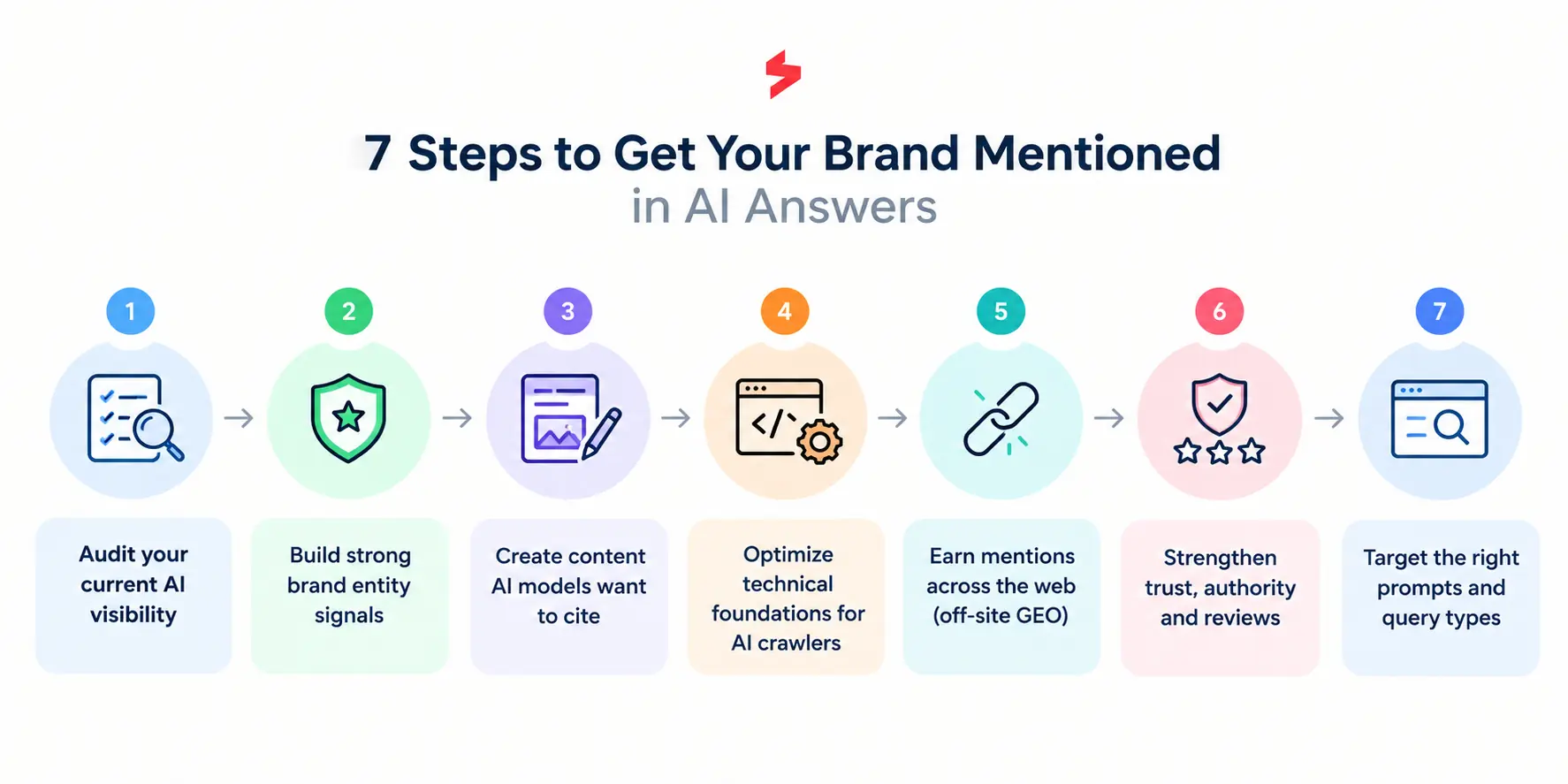
Step 1: Audit your current AI visibility
Use your prompt tally as a baseline, then run the same questions for two competitors. Comparing which brands get mentioned shows you where your brand is missing out.
Step 2: Build strong brand entity signals
Write one clear sentence explaining what you do and who you help, then use it on your site, LinkedIn and directory profiles. AI works better when it can place you in a category without guessing.
Step 3: Create content AI models want to cite
Put the direct answer in the first 40 to 50 words under each question-style heading. AirOps found that 68.7% of ChatGPT-cited pages follow a logical heading hierarchy, so tidy structure isn't cosmetic.
Step 4: Optimize technical foundations for AI crawlers
Check that robots.txt isn't blocking your key pages, keep important text out of heavy JavaScript and add schema where it matches visible content. You can skip LLMs.txt for now, because Google has said it won't use LLMs.txt for AI Overviews.
Step 5: Earn mentions across the web (off-site GEO)
Aim for a few quality placements rather than many weak ones, such as guest articles, expert quotes, podcast appearances and review sites your buyers actually read. Ahrefs found Domain Rating correlated only 0.326 with AI Overview brand visibility, so don't chase authority scores alone.
Step 6: Strengthen trust, authority and reviews
Show real names, credentials, case studies and customer reviews on your pages. When two brands look similar, clear proof helps AI understand which one is the better fit.
Step 7: Target the right prompts and query types
Focus on decision-stage questions, where a brand name is expected in the answer. This helps your brand appear in AI search results when someone is ready to choose.
How to track and measure your AI visibility
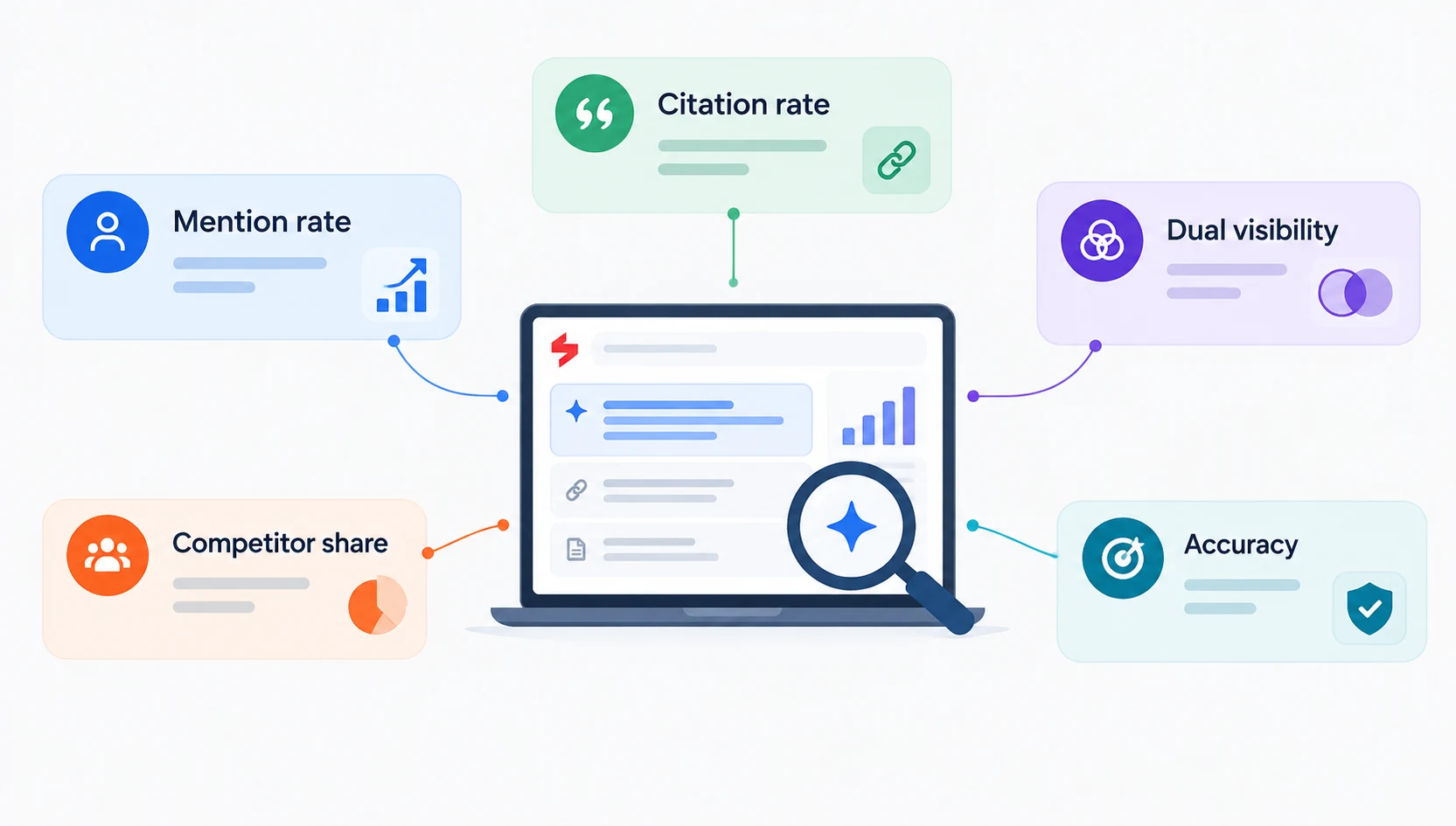
Manual prompt checks are a good start. To measure properly, track these five things each month:
- Mention rate: how often the AI mentions your brand by name.
- Citation rate: how often the AI uses your website or pages as a source.
- Dual visibility: both at once. AirOps found only 28% of AI answers include brands with both, so this is a useful benchmark to beat.
- Competitor share: how often you're named compared with two or three rivals.
- Accuracy: whether the AI describes you correctly.
Run each prompt several times, since answers vary, and report results for each platform separately instead of averaging them. Check your analytics for referral visits from AI tools and use Google Search Console for Google's AI features. Treat the numbers as trends, not exact scores.
Best AI SEO tools and services to improve rankings and AI visibility
The right setup for AI answer optimization depends on your budget, team and goals. Start with what the tools do, then move on to who can help.
What AI-powered SEO tools can help improve your website's search rankings quickly?
Tools fall into four groups:
- Content optimization: Surfer, Clearscope, Frase
- Technical auditing: Screaming Frog
- Keyword and topic research: Semrush, Ahrefs
- AI visibility tracking: Profound, Otterly, Peec AI
Which companies provide AI SEO optimization with proven success stories?
Judge proof by named clients, measurable results, a stated timeframe and a similar industry. Red flags include guaranteed rankings, vague case studies and no explanation of method. Before hiring, ask: what exactly will you change, how will you measure AI visibility and what results should I expect by when?
Where can you find AI SEO services that integrate with popular CMSs?
Check support for WordPress, Shopify, Webflow, Wix, HubSpot or your headless setup. Plugins are quick to install but limited. API or app-based integrations take longer but fit complex workflows. Confirm what data the service can access, who has edit permissions and whether it fits how your team already publishes.
Which AI SEO services provide content optimization tailored to your industry?
A SaaS brand, an online store, a clinic and a local plumber need different content. Healthcare and finance need extra care with accuracy and compliance. Test any provider with a sample audit and industry examples. Sociyell offers a free LLMO visibility audit, which is a low-risk way to see this in action.
Quick comparison
| Type | Best for | CMS fit | Industry fit | Pricing model | Limitation |
|---|---|---|---|---|---|
| Content optimization tools | Improving page quality | Often plugins or editors | General | Subscription | Won't build authority |
| Technical auditing tools | Fixing crawl issues | Works on any site | General | License or subscription | Needs someone to act on findings |
| Research suites | Finding topics and gaps | Not CMS-based | General | Subscription | Heavy for small teams |
| AI visibility trackers | Measuring mentions | Not CMS-based | General | Subscription by prompts | Shows problems, doesn't fix them |
| Agency or service | Doing the work end to end | Varies, so ask | Ask for samples | Retainer or project | Quality varies widely |
Selection checklist
- Budget: can you sustain it for at least six months?
- Team size: do you have someone to act on the findings?
- Goals: rankings, AI mentions or both?
- Integrations: does it work with your CMS?
Your 30-60-90 day AI visibility action plan
Work through these in order. Each step builds on the one before it.
| Priority | When | Action | Why it comes here |
|---|---|---|---|
| 1 | Days 1–30 | Run your prompt audit and fix crawl blocks | Shows the gaps and removes the cheapest barriers |
| 2 | Days 1–30 | Rewrite top pages with answers up front | Fast to do, easy to measure |
| 3 | Days 31–60 | Publish comparison and "best for" pages | Targets the content that earns names |
| 4 | Days 31–60 | Create one original data point or named framework | Gives AI something to credit to you |
| 5 | Days 61–90 | Pitch guest articles, podcasts and review sites | Third-party mentions take longest to land |
| 6 | Days 61–90 | Re-run the audit and compare | Proves what worked |
Conclusion
There's no secret to how to rank in AI answers. It comes down to being easy to retrieve, clearly described and talked about by sources people trust. You'll also get more value by treating mentions and citations as two scores instead of one.
Start small. Run the prompt test this week, rewrite your five most important pages and review your results at day 90. If you'd like a head start, Sociyell offers a free LLMO visibility audit.
Frequently asked questions
How do I get my brand mentioned by AI?
Make it easy for AI to understand what you do, then give it reasons to name you. Publish clear, answer-first pages, describe your brand consistently across the web and earn mentions on sites your buyers trust. Comparison and "best for" pages can also help. To see where your brand stands today, Sociyell offers a free LLMO visibility audit that assesses your AI visibility and identifies areas to improve.
How do I get my company to show up in AI results?
Start by making sure AI can reach your pages. Don't block them in robots.txt, and keep key content in plain text instead of hiding it behind heavy JavaScript. Then target the questions customers ask when they're ready to choose, since that's where companies actually get named.
How do I get AI to recommend my product?
Give it proof it can repeat: specific use cases, customer reviews, original data and a clear statement of who the product is for. AI recommends what it can confidently place in a category. Vague claims like "the best solution" give it nothing to work with.
How do I get cited by AI?
Put a direct answer in the first 40 to 50 words under a question-style heading, then back it up with evidence or an example. Use a logical heading structure and keep statistics current. Original research or a named framework gives AI something specific to credit to you.
Why does my brand appear on one platform but not another?
Each platform uses different sources, retrieval methods and ways of choosing brands, and results change from one run to the next. Track each platform separately and test the same prompts more than once before drawing conclusions.
